5 AI Agents Every B2B SaaS Marketer Should Build First
If you are a B2B SaaS marketer who wants to start building AI agents but does not know where to begin, this is the roadmap. Not 20 agents. Not an entire marketing operating system. Five agents, in a specific order, that will give you the highest return on time invested and set the foundation for everything you build after.
I have built over 25 agents for my own marketing operation. The order matters. Each agent builds on the last. By agent five, you have a connected system, not a collection of tools.
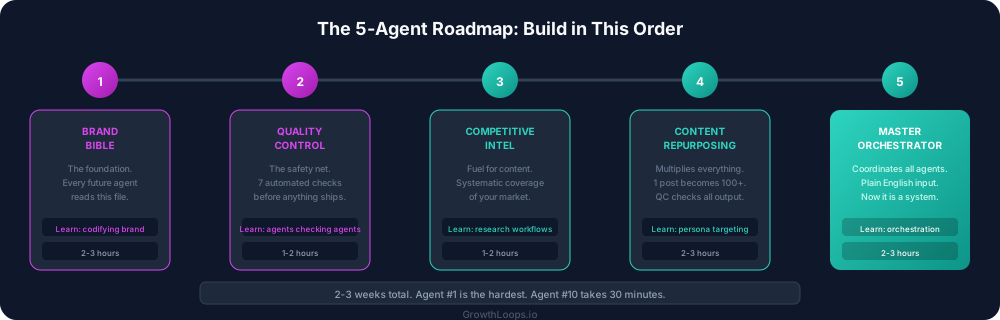
Agent 1: The brand bible
Build this first because: every agent you build after this reads it. The brand bible is the foundation of your entire system. Without it, everything you build produces generic output. With it, everything sounds like your brand from day one.
What it is: a CLAUDE.md file with your business context, buyer personas, brand voice rules, banned words, and competitive positioning. Not a traditional brand guidelines document. A living file that AI agents read on every execution.
Why it matters: the difference between "Are you struggling to scale your B2B SaaS marketing?" and content that sounds like a specific person wrote it for a specific buyer. That difference is entirely driven by the brand context.
Time to build: two to three hours for a thorough first version. You will refine it continuously.
What you learn: how to codify your brand knowledge in a way that AI can operationalize. This is the single most valuable marketing exercise most teams have never done. It forces you to articulate your personas, your voice, and your positioning with a precision that most teams avoid.
Agent 2: The quality control agent
Build this second because: before you start producing content at scale, you need the safety net in place. Building QC early means everything you create from this point forward gets checked automatically.
What it does: reviews every piece of content against your brand rules. Seven checks: banned words, voice compliance, persona alignment, messaging pillar accuracy, CTA compliance, specificity, and format compliance. Each check produces a pass or fail with specific violations and revision suggestions.
Why it matters: quality at scale is impossible without automation. A human reviewer catches some issues some of the time. The QC agent catches all issues every time. It is the editor that never gets tired and never misses a banned word.
Time to build: one to two hours. It reads your brand bible for the rules.
What you learn: how to build agents that evaluate output against a set of criteria. This is the moment you understand that agents are not just producers. They are reviewers too.
Agent 3: The competitive intelligence scanner
Build this third because: now that your brand context and quality system are in place, you need intelligence to fuel your content. Competitive insights drive content strategy. The scanner gives you systematic coverage instead of anecdotal awareness.
What it does: scans competitor ad libraries across Meta, LinkedIn, and Google. Extracts messaging patterns, pain points targeted, value propositions, CTAs, and creative formats. Identifies gaps in the competitive messaging landscape.
Why it matters: most B2B SaaS marketers know what their competitors are doing at a surface level. They saw an ad last week. They checked a landing page last month. The competitive intelligence agent gives you real-time, structured intelligence you can act on immediately.
Time to build: one to two hours for a basic version. You will refine it over the next few weeks.
What you learn: how to give an AI agent specific instructions for research workflows, how to review and refine output, and how to think about tasks as repeatable systems.
Agent 4: The content repurposing engine
Build this fourth because: you now have brand context, quality control, and competitive intelligence. The repurposing engine multiplies everything you create from this point forward. The ROI compounds with every piece of content you produce.
What it does: takes one piece of content and generates versions across multiple narrative angles, output formats, and target personas. One blog post becomes LinkedIn posts, email sequences, TikTok scripts, ad copy, and more.
Why it matters: content production is the bottleneck for most marketing teams. Not because they cannot write. Because the reformatting, retargeting, and redistributing takes more time than the original creation. The repurposing engine eliminates that bottleneck. And every piece runs through the QC agent you already built.
Time to build: two to three hours. It reads your brand bible, so the output is on-brand from the first run.
What you learn: how agents can produce persona-specific variations of the same core insight. This is where most marketers realize the potential of the system.
Agent 5: The master orchestrator
Build this fifth because: you now have four agents that work together. The orchestrator is what makes the system accessible to anyone on your team.
What it does: takes plain English instructions, plans which agents to run and in what order, executes each one with the right inputs, runs QC on all outputs, and delivers a complete package.
Why it matters: without the orchestrator, running a multi-agent workflow requires knowing which agents exist, what order to run them, and how to pass output from one to the next. With the orchestrator, anyone can run the full system by describing what they need.
Time to build: two to three hours. This is the most complex agent, but by this point you have built four others and the pattern is familiar.
What you learn: how to build an agent that coordinates other agents. This is the skill that transforms a marketer into a go-to-market engineer.
The progression after five
Once you have these five agents, you have a connected marketing operating system. The brand bible defines the standard. The QC agent enforces it. Competitive intelligence fuels content decisions. The repurposing engine multiplies everything. The orchestrator coordinates it all.
From here, every new agent plugs into the existing system. An email agent reads the brand bible and runs through QC. A meeting prep agent reads the competitive intelligence. A visual brief agent feeds off the content engine.
The first five agents take two to three weeks if you are building alongside your regular work. Every agent after that takes a day or less because the foundation is in place.
Start with the brand bible. Add quality control. Build competitive intelligence. Layer on content repurposing. Connect with the orchestrator. That is the roadmap. The rest is iteration.