AI Agents Are Not Chatbots. Stop Treating Them Like One.
The biggest mistake marketing teams make with AI is using agents like chatbots. They open Claude Code, type a question, read the answer, and move on. That is not building. That is chatting.
The difference matters because it is the difference between a tool that makes you slightly faster at individual tasks and a system that fundamentally changes what your team can produce.
I built 25 AI agents for my marketing operation. Not one of them works like a chatbot. Here is the distinction and why it changes everything.
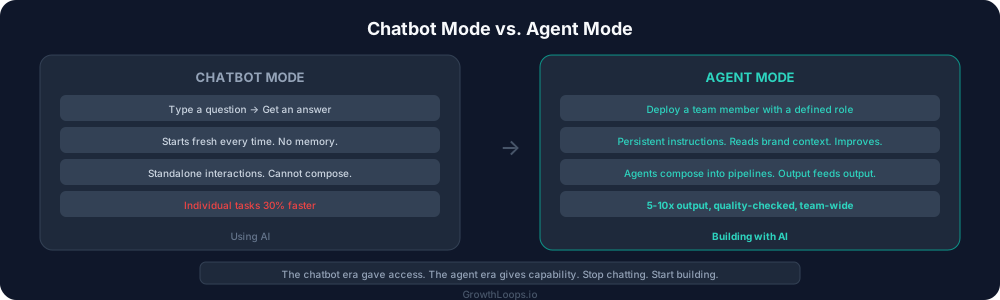
A chatbot answers questions. An agent does a job.
When you use ChatGPT to write a blog post, you are having a conversation. You type a request. It responds. You refine. It revises. The interaction is back-and-forth, synchronous, and temporary. When you close the window, the conversation is gone.
When you run a marketing agent in Claude Code, you are deploying a team member. The agent has a defined role (competitive intelligence analyst, content writer, quality control editor). It has instructions it follows every time (scan these platforms, format the output this way, check against these rules). It reads your brand context before it starts. And it exists permanently as a skill file in your project.
The chatbot interaction: "Can you write me a LinkedIn post about marketing leadership?"
The agent interaction: You type /gl-linkedin 1 Alex and the agent writes a LinkedIn post for Pillar 1 (You Have Outgrown Founder-Led Growth) targeting the Alex persona (overloaded Founder-CEO). It reads your brand bible, applies your voice rules, avoids your banned words, and includes specific proof points from your career. Every time.
The first approach gives you a post. The second approach gives you a system for producing posts.
The three things that make an agent different from a chatbot
Persistent instructions. A chatbot starts fresh every time. An agent has a permanent instruction set that defines its role, its process, and its quality standards. Those instructions get refined over time. The agent gets better. A chatbot stays the same.
Brand context. A chatbot does not know your brand. An agent reads your CLAUDE.md file on every execution. It knows your personas, your voice, your positioning, your banned words, and your proof points. The output is brand-native, not brand-adjusted.
Composability. A chatbot is a standalone interaction. An agent is part of a system. The competitive intelligence agent's output feeds the content agent. The content agent's output feeds the QC agent. Agents compose into workflows that produce outcomes no single chatbot conversation could.
Why marketing teams get stuck in chatbot mode
Three reasons.
Familiarity. Everyone knows how to use a chatbot. You type, it responds. Building an agent requires a different mental model: define the role, write the instructions, create the skill file, test and refine. It is a small learning curve, but it is a curve.
Instant gratification. A chatbot gives you output in 30 seconds. Building an agent takes an hour or two before you see the first output. The payoff is much larger, but it is not immediate. People default to the faster dopamine hit.
Misunderstanding the tool. Most marketing teams were introduced to AI through ChatGPT. They learned to use AI as a chatbot. When they encounter Claude Code, they use it the same way. Nobody told them the difference. Nobody showed them what an agent looks like.
How to make the shift
The shift from chatbot user to agent builder happens in one exercise.
Pick a task you do repeatedly. Not a creative, one-off project. A repeatable workflow. Competitive research. Content reformatting. Email drafting. Performance summarizing.
Write down the instructions as if you were training a new hire. What do they need to know? What are the inputs? What should the output look like? What rules should they follow? What mistakes should they avoid?
Save those instructions as a skill file. Put them in .claude/commands/your-agent.md. Now you have an agent. Run it. Refine the instructions based on the output. Run it again.
You just stopped chatting and started building. The agent exists permanently. It runs the same way every time. It reads your brand context. It can be improved iteratively. It can be composed with other agents.
That is the shift. It takes one exercise to understand. And once you see the difference, chatbot mode feels like using a calculator to do what a spreadsheet could do.
What happens when your team makes the shift
A marketing team using AI as a chatbot gets marginal productivity gains. Individual tasks happen 30% faster. That is real but limited.
A marketing team building AI agents gets structural capability gains. Content output multiplies 5x to 10x. Quality becomes consistent through automated QC. Competitive intelligence goes from quarterly to continuous. Multi-channel content production goes from a week-long process to an afternoon.
The difference is not incremental. It is categorical. One team is using AI. The other team is building with AI. The outcomes are not comparable.
The chatbot era gave everyone access to AI. The agent era gives marketing teams the ability to build AI into their operating system. The teams that make the shift will have capabilities that chatbot-mode teams cannot match.
Stop chatting. Start building.