AI Agents vs Zapier: When Workflow Automation Isn't Enough
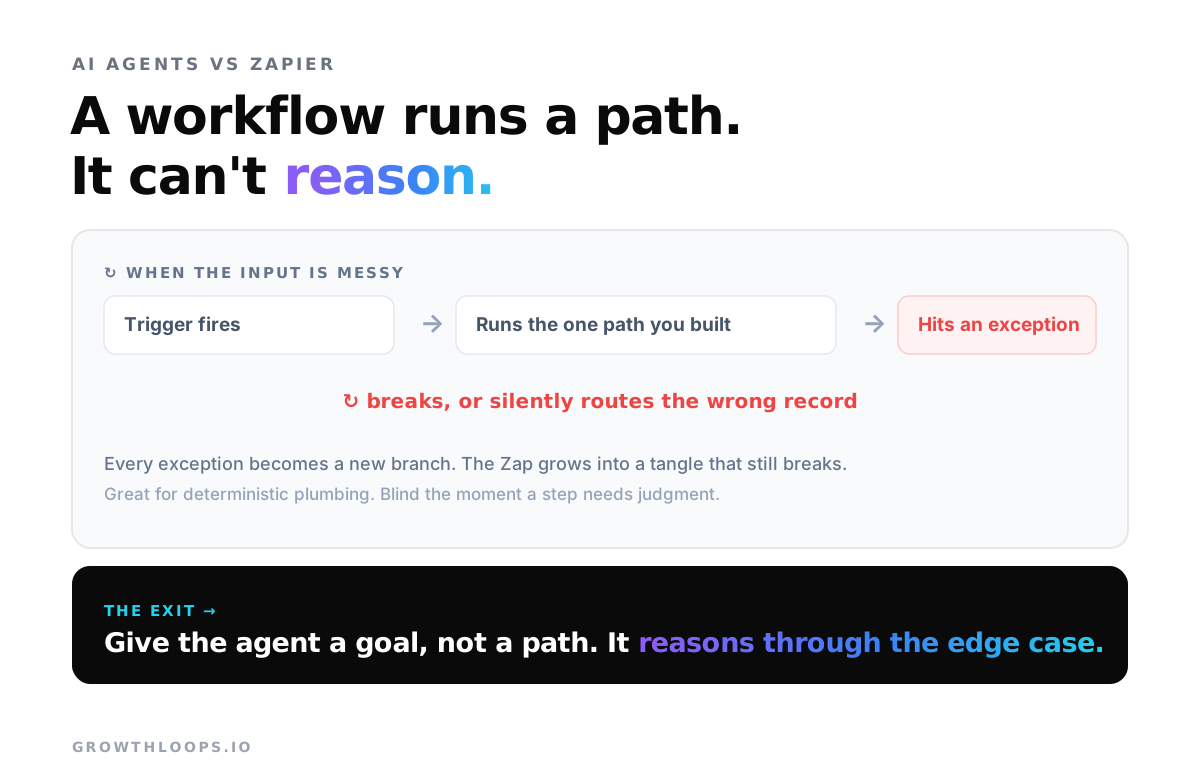
Zapier is a wiring harness. It moves data from one system to another when a trigger fires. That is useful, and it is also the ceiling. The moment a step needs judgment, your Zap breaks or routes the wrong record to the wrong place.
If you run RevOps, you already feel this. Your HubSpot workflows, your Make scenarios, and your Zaps are doing real work. They are also brittle, linear, and incapable of reasoning. Every edge case becomes a new branch. Every new branch becomes a new thing that breaks at 2am.
Agentic AI is the next layer of the stack, not a competitor to the one you already run. This is the architecture, not the hype.
What is the difference between an AI agent and a Zapier workflow?
A Zapier workflow is a fixed sequence: trigger, action, action, done. It executes the exact path you defined. It cannot decide that this lead is different and should be handled another way.
An AI agent is a worker with a role, a system prompt, a set of tools, and a feedback loop. You give it a goal instead of a path. It reasons about the input, chooses which tools to call, and produces an output you can evaluate and correct.
Zapier asks "did the trigger fire?" An agent asks "what is the right thing to do with this?" That single difference is why one breaks on edge cases and the other handles them.
Are AI agents better than Zapier?
Not better. Different layer. Keep Zapier for what it is good at, which is deterministic plumbing. When a record changes in HubSpot, write it to your data warehouse. When a form is submitted, create a deal. That work is rule-based and should stay rule-based.
Use an agent when the task requires judgment that you cannot fully specify in advance. Qualifying an inbound lead from a messy form fill. Drafting a personalized follow-up that reads the account context. Reading a competitor's pricing page and flagging what changed. You cannot pre-wire every branch of that decision. An agent reasons through it.
The test is simple. If you can write the rule, use a workflow. If the rule has too many exceptions to write, use an agent.
Why do Zapier workflows break so often?
Because they are linear and they cannot reason. A Zap encodes one happy path. Real GTM data is not a happy path. It is incomplete fields, duplicate records, weird formatting, and inputs you did not anticipate when you built the automation.
Every time reality differs from your assumption, the workflow either errors out or does the wrong thing silently. So you add a filter. Then a path. Then a formatter step. The Zap grows into a 14-step tangle that only you understand, and it still breaks.
An agent absorbs that variance. It reads the input, recognizes the edge case, and handles it the way a competent human would, because you gave it the context to reason instead of a rigid script to follow.
What is an agentic workflow?
An agentic workflow is a system where agents with defined roles handle the reasoning steps, and deterministic automation handles the wiring around them. It is not "replace Zapier." It is "put a brain where the judgment lives."
The anatomy has four parts. A role, which is the job the agent owns. A system prompt, which is its operating context, your ICP, your brand rules, your definition of good. Tools, which are the systems it can read from and write to. And a feedback loop, where a human reviews output and the agent gets sharper.
In practice it looks like this. Zapier catches the form fill and hands it to an agent. The agent reads the lead against your ICP, enriches it, decides routing, and drafts the outreach. A human owns the output. Deterministic automation does the catching and the writing. The agent does the thinking in the middle.
How does Claude Code fit into this?
Claude Code is where you build and run these agents. You define an agent as a skill file: its role, its system prompt, its tools, and its guardrails. That file is version-controlled, readable, and yours. It is not a black box inside a SaaS vendor's UI.
The connection to your existing stack runs through MCP, the Model Context Protocol. MCP is the standard that lets an agent talk to your real tools, your CRM, your warehouse, your docs, without custom glue code for each one. It is the integration layer that makes an agent operational instead of a demo.
So the upgrade path is concrete. Your Zaps stay as the plumbing. Claude Code holds the agents that reason. MCP connects the agents to the systems you already run. You are extending the stack, not ripping it out.
How do I move from workflow automation to agentic workflows?
Start where a workflow already breaks. Find the Zap or HubSpot workflow that fails most often, the one with the most branches and the most exceptions. That is where reasoning is missing, and that is your first agent.
Then build incrementally. Give that one agent a clear role and a tight system prompt. Wire it into your existing automation through MCP so it reads and writes to the tools you already use. Put a human review step in front of the output so the feedback loop is real from day one.
You are not rebuilding your stack. You are inserting judgment where your linear automation runs out of road. One agent, one broken workflow, one feedback loop at a time. That is how a RevOps system levels up without a rip-and-replace.
What stays automation and what becomes an agent?
Keep as deterministic automation: field syncs, record creation, status updates, notifications, anything you can write as a firm rule. This is the work Zapier and HubSpot workflows do well, and there is no reason to touch it.
Move to agents: lead qualification, personalized drafting, research and enrichment, competitive monitoring, any step where the right answer depends on context you cannot fully encode in advance. These are the steps where a human used to step in. Now an agent handles the first pass and the human owns the call.
The architecture that wins is both. Deterministic plumbing for the predictable. Agents for the judgment. A human who owns the output and tightens the loop. That is the operating model, and it is more durable than any single tool you bolt on.
Most RevOps leaders already have the systems instinct for this. The missing piece is the build. If you want to see how this stack comes together inside Claude Code, that is what we teach your team to do in a workshop, with your real workflows as the starting point.