ChatGPT vs Claude Code for Marketing Teams: Why Prompting Isn't Building
Most marketing teams think they have an AI practice. What they actually have is a browser tab open to ChatGPT, where someone types one question at a time and pastes the answer into a doc.
That is not an AI practice. That is prompting. And prompting has a ceiling.
The teams pulling ahead right now made a different move. They stopped chatting with AI and started building with it. They moved into Claude Code, the environment where you assemble agents that do the work instead of answering questions about it. Almost no one in marketing is here yet. That is exactly why being early matters.
What is the difference between ChatGPT, Claude, and Claude Code?
They are three different things, and the gap between them is the whole story.
ChatGPT is a chat assistant from OpenAI. You ask, it answers. Great for one-off tasks: draft this email, summarize this report, rewrite this paragraph. Most marketers live here.
Claude is a chat assistant from Anthropic. Same shape as ChatGPT, different model. A few marketers have moved over for the writing quality. Still a chat box. Still one question at a time.
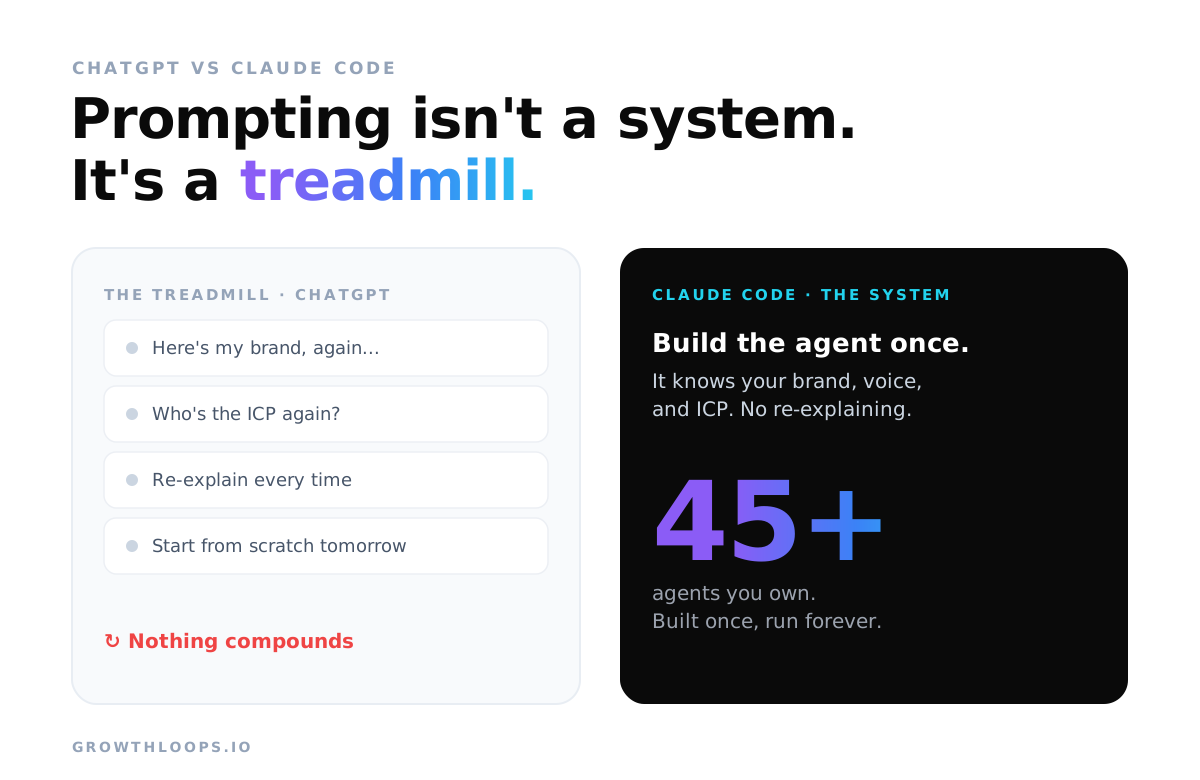
Claude Code is not a chat box. It is an environment where you build agents: small, named workers with a defined role, a system prompt, and a feedback loop. You do not ask Claude Code to write one blog post. You build a content agent that knows your brand voice, your ICP, and your banned-words list, then runs every time you need it.
ChatGPT is where you prompt. Claude Code is where you build. Different category of work.
Is Claude Code better than ChatGPT for marketing teams?
For quick, throwaway tasks, ChatGPT is fine and fast. If you need one subject line right now, open ChatGPT and get it. No build required.
The problem is that nothing you do in ChatGPT compounds. Every prompt starts from zero. You re-explain your brand, your audience, and your rules every single time. The output disappears into a doc and the next person reinvents it tomorrow. You own nothing.
Claude Code is better when the work repeats, which in marketing is almost all of it. Content, competitive intel, outbound, repurposing, QC. You build the agent once. It carries your context every time. The work gets sharper as you refine it. You own the system, not just the answer.
So it is not that one tool wins. It is that prompting and building are different jobs. ChatGPT handles the one-off. Claude Code handles the engine.
Why isn't prompting ChatGPT enough for a marketing team?
Prompting tops out fast, and here is where it stops.
Nothing is owned. A prompt lives in a chat window. When the tab closes, the value is gone. You cannot hand a prompt to a teammate as a working asset.
Nothing compounds. Every session restarts the context. You are not building institutional knowledge. You are paying the same setup tax over and over.
It does not scale past you. Your AI output is capped by how many questions one person can type in a day. That is the same ceiling as doing the work by hand, just slightly faster.
It stays generic. Without your brand context wired in, ChatGPT gives you competent, average copy. It reads like everyone else's AI copy, because it is.
A marketing team prompting ChatGPT is a team using AI as a faster typewriter. Useful. Not a competitive advantage. Your competitors have the same typewriter.
What does building agents in Claude Code actually look like?
An agent is a worker you define once and run forever. The mental model is simple: brand context plus a strategy doc plus a skill equals output.
You give an agent a role, like competitive intel analyst. You write its system prompt so it knows your ICP, your positioning, and what good looks like. You give it a feedback loop so it improves. Then it runs on demand, in your voice, without you re-explaining anything.
I run my own marketing this way. I have built 45-plus production agents plus a composable skills layer my team mixes and matches. Content. Outbound. Competitive intelligence. Quality control. Strategy audits. The agents produce the execution layer. The humans make the decisions and own the output.
That is the difference between asking AI a question and putting AI on your team. One is a conversation. The other is capacity you keep.
Why is being early to Claude Code a competitive advantage?
Adoption here is a step function, not a smooth curve.
Most marketers are still prompting ChatGPT one question at a time. A handful have switched to Claude, the chat assistant. The number building actual agents in Claude Code is close to zero. That gap is the opportunity.
Building advantage compounds. The team that started three months ago already has refined brand context, agents that get more accurate each week, and workflows their competitors have not even scoped. A late mover cannot close that distance with a bigger ChatGPT subscription. There is no setting for "the system the other team already built."
This is not about replacing your marketers. It is about making the team you already have produce like a team three times the size. You do not need ten more hires. You need the people you have to learn how to build.
The tools are ready. The frameworks exist. The only variable is whether your team is still asking AI questions or starting to build with it.
If your team has hit the ceiling of prompting and wants to see what building looks like, that first agent is closer than you think. Come build one with us in a workshop, and your team walks out owning something real.