Cold Email Without the Cringe: How an AI Agent Writes Outbound That Gets Replies
Cold email has a reputation problem. And it deserves it. Most cold email is terrible. It is generic, it is long, it is obviously templated, and it asks for a meeting in the first sentence like you owe the sender something.
I have been on the receiving end of thousands of these. As a marketing leader at multiple B2B SaaS companies, my inbox was a graveyard of "I noticed your company is growing" and "Would you be open to a quick chat?" Nobody reads those. Nobody replies. And the people sending them burn through their prospect lists wondering why outbound does not work.
But cold email itself is not broken. The approach is broken. When a cold email is specific to the person, specific to their situation, and leads with empathy instead of an ask, it works. I have written cold emails that got meetings with CTOs, VPs of Marketing, and founders at companies doing $20M or more in ARR. The difference is always the same: specificity.
The problem is that writing specific, personalized cold emails takes time. Researching the company, understanding the pain points, crafting a message that sounds human. You cannot do that at scale with a template. And you cannot do it at scale manually.
So I built two AI agents. One writes single personalized cold emails. The other builds full three-email sequences. Both are trained on what actually gets replies.
The cold email agent
The cold email agent writes one email at a time. Highly specific. Not templated. You give it four inputs: the prospect's name, their company, their approximate ARR, and the pain point you think they have.
The agent does the rest.
Subject line: Three to seven words. No clickbait. No "Quick question" or "Reaching out." Something specific to their situation that makes them curious enough to open it.
Body: Five to seven sentences. That is it. The structure follows a pattern I have tested across hundreds of outbound emails:
- Sentence 1: Acknowledge something specific about their company or situation. Not "I noticed you are growing." Something that shows you actually looked.
- Sentences 2 to 3: Name the pain point. Not generically. In their language, from their perspective. The prospect should read this and think "this person gets it."
- Sentences 4 to 5: The bridge. How what you do connects to their specific problem. No feature dumps. No "we help companies like yours." One clear value statement.
- Sentence 6: The CTA. One ask. Soft. Usually a question that is easy to say yes to.
The agent checks every email against the brand voice rules. No banned words. No hard sell. No filler. If it cannot write something specific and genuinely useful for that prospect, it says so instead of generating garbage.
The email sequence agent
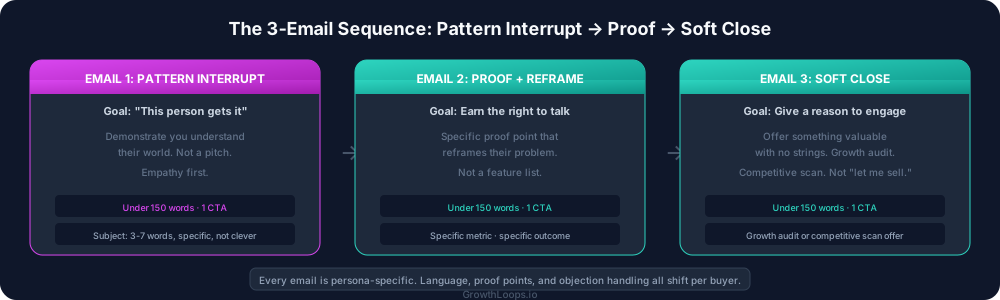
The sequence agent builds three-email campaigns designed for different stages of the relationship. You give it a persona and an intent (cold outreach, follow-up, or nurture), and it generates the full sequence.
Email 1: Pattern interrupt plus empathy. This is not a pitch. It is a demonstration that you understand their world. The goal is to get the prospect to think "this person sees the problem I am dealing with." Under 150 words. One CTA.
Email 2: Proof plus reframe. Now you earn the right to talk about yourself. But not with a feature list. With a specific proof point that reframes their problem. If they think the problem is "we need more leads," this email shows them the real problem is "your leads are not converting because your positioning is wrong." Specific metric. Specific outcome. Under 150 words. One CTA.
Email 3: Soft close plus growth audit offer. The final email in the sequence does not beg for a meeting. It offers something valuable with no strings attached. A growth audit. A competitive scan. Something that gives the prospect a reason to engage beyond "let me sell you something." Under 150 words. One CTA.
Every email in the sequence is persona-specific. The language, the proof points, and the objection handling all shift based on whether you are writing to an overloaded founder, a burned buyer, or a technical founder.
What makes this different from sales tools with AI
Every sales engagement platform now has an "AI email writer" feature. They all produce the same thing: slightly personalized templates that sound like every other slightly personalized template in the prospect's inbox.
The difference with this agent is context depth.
It knows the personas. Not just the job title. The fears, the buying triggers, the objections they are likely to raise, and the proof points that will resonate with each of them.
It knows the objection library. The agent references 12 documented objections with proven reframes. It proactively addresses the most likely objection for each persona in the email copy so the prospect does not even get to that objection on the call.
It knows the brand voice. The emails do not sound like sales automation. They sound like a person who understands the prospect's world wrote them by hand. Because the voice rules enforce specificity, empathy, and directness over template language.
The speed difference
Time per email dropped from 15 to 20 minutes (for a truly personalized email) to under 2 minutes. The agent does the research and the drafting. I review, add a personal touch, and send.
That speed change is what makes personalized outbound viable at scale. You are no longer choosing between personalization and volume. The agent handles both.
Where it fits in the system
The email agents work best when they are connected to the rest of the marketing operating system. Run the competitive ads agent to understand what messaging is in market. Feed the insights into the email agent so your outbound references the competitive landscape the prospect is navigating.
Use the objection coach to identify the most likely pushback for each persona. The email sequence agent proactively addresses those objections so your prospect arrives at the meeting already past the biggest hurdle.
Run the strategy audit for a prospect's company before you reach out. Now your cold email references specific gaps in their marketing strategy that they did not expect you to know about. That is the email that gets a reply.
The agents compound. One agent's output becomes another agent's input. That is the difference between using AI to write faster and building an AI-powered go-to-market operating system.