How to Get Your Marketing Team to Actually Adopt AI (Not Just Try It)
Adoption is not an information problem. It is a doing problem.
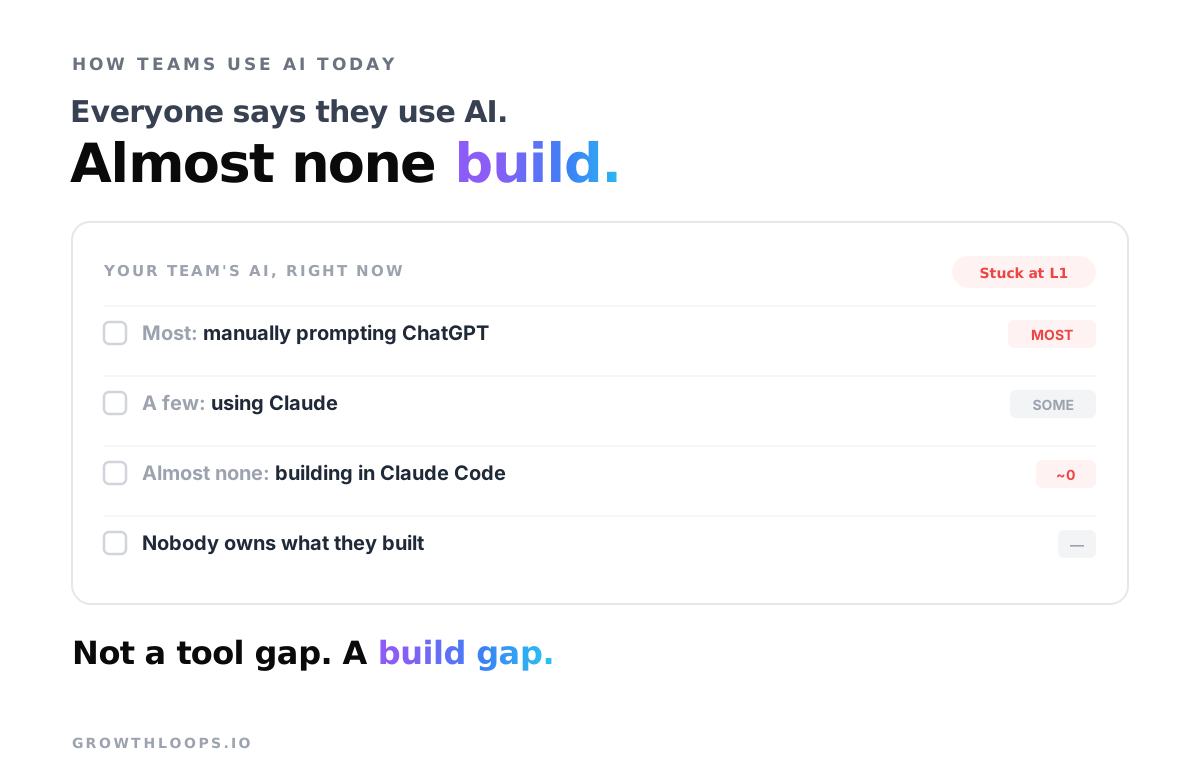
Your team has already heard the AI pitch. Here is what their AI use actually looks like today. Most marketers are manually prompting ChatGPT, one question at a time, pasting the answer into a doc and moving on. A few have graduated to Claude. Almost none are in Claude Code, the environment where you actually build agents instead of chatting with one. That is not adoption. That is typing into a chat box, and it is the ceiling. Nothing sticks because nothing is owned and nothing compounds.
That is the pattern I see in almost every marketing org I train, from 7-person startups to 85-person public-company marketing teams. The teams that actually adopt AI are not the ones who learned the most about it. They are the ones who built something useful with their own hands.
Why do marketing teams try AI but never actually adopt it?
Most teams stall because their AI use never got past prompting. Manually asking ChatGPT for copy is the most common form of marketing AI today, and it is also a dead end. There is nothing to own, nothing to refine, and nothing that compounds. You get an answer, you paste it, you start over tomorrow.
Where there was training, it usually stopped at concepts. Someone showed them what AI can do. They nodded. They were impressed. Then Monday came and they had no idea what to actually do at their desk. So they went back to the way they already worked, because the old way was the only way they knew how to finish their work.
A demo creates interest. It does not create capability. Watching someone build a competitive intel agent is not the same as having one you built yourself, sitting in your own workflow, doing your own job.
This is the gap. Interest is easy to generate. Capability is the thing that survives contact with a real deadline. And capability only comes from building.
What actually drives AI adoption on a marketing team?
People adopt AI when they build something with their own hands that makes their own job easier.
That is the whole mechanism. Not a mandate from leadership. Not a tool license. Not a lunch-and-learn. A marketer adopts AI the moment they have a working agent they built themselves and it saves them an hour on a task they hated.
Here is what changes in that moment. The marketer stops seeing AI as a thing being done to them and starts seeing it as a thing they own. They built it. They understand it. They can change it. When the next problem shows up, their first instinct is to build for it instead of grinding through it manually.
That shift in instinct is adoption. Everything else is just exposure.
Why does build-based training beat concept-based training every time?
Concept training ends with a deck. Build training ends with a working agent.
When I run a session, no one leaves with notes about what AI could theoretically do. They leave with an agent they built in Claude Code, the AI coding tool we train marketing teams on. A content repurposing agent. A competitive intel agent. A landing page builder. Something real that runs on their own brand and their own work.
The difference shows up the next morning. A team that watched a demo has nothing to use on Monday. A team that built an agent has a tool waiting for them, already producing output, already tied to a task they own.
That is why most AI training fails. It teaches people what AI is instead of teaching them to build. Your team walks out impressed and walks back in helpless. Build-based training closes that loop. The session ends with the marketer using the thing they made.
How long before a marketing team actually starts using AI?
Faster than you think. The first working agent comes in about 45 minutes.
I have trained teams where no one had ever opened a terminal. By the end of the first session, they had built something that worked. Not a toy. A real agent doing a real piece of their job. That first build is the unlock, because it proves the thing they were afraid of is something they can actually do.
From there the curve is steep. The marketer who built one agent builds a second one on their own that week, for a problem no one assigned them. That is the signal you are looking for as a leader. Not attendance. Not enthusiasm in the room. Self-directed building afterward.
This holds across team sizes. A 7-person startup and an 85-person marketing org adopt through the exact same mechanism. The org chart changes. The psychology does not. People own what they build.
What should a marketing leader do to make AI stick?
Stop buying tools and start building skills.
A tool gives your team access. It does not give them capability, and it does not give them ownership. When the tool changes or the vendor raises prices, your team is stuck, because they never learned to build. They only learned to log in.
Here is the order that works.
Pick one painful, repetitive task your team already hates. Have each marketer build one agent that handles a piece of it, with their own hands. Make the session end with that agent running, not with a recap slide. Then watch who builds a second one on their own.
That last step is your adoption metric. You are not measuring whether they tried AI. You are measuring whether they reach for building before they reach for grinding. When that instinct flips across the team, adoption is no longer a project you are managing. It is just how your team works now.
The teams that build are the teams that adopt
A demo makes your team interested for a day. A working agent they built themselves makes them capable for good.
The marketing teams pulling ahead right now are not the ones with the most AI tools or the most AI enthusiasm. They are the ones whose marketers know how to build. That skill compounds. Every agent they build makes the next one faster, and every win makes the next problem feel like something to build for instead of something to suffer through.
If your team has tried AI and nothing stuck, the answer is not another tool or another demo. It is putting a build in their hands. If you want to see what that looks like for your team, GrowthLoops runs hands-on workshops where your marketers leave with a working agent they built themselves. That is where adoption actually starts.