How an AI Agent Writes LinkedIn Posts That Sound Like Me, Not a Robot
You can spot AI-written LinkedIn content from a mile away. It starts with a question. It uses words like "synergy" and "leverage." It has that weird em dash cadence that screams "I pressed a button and pasted the output." Every post sounds like it was written by the same person because it was written by the same default model with zero context about who you are or what you actually believe.
I refused to post that way. But I also could not spend 45 minutes crafting every LinkedIn post when I needed to be publishing three to four times a week. So I built an AI agent that writes LinkedIn posts in my voice. Not a voice that kind of sounds like me. My actual voice.
Here is how it works and why it is different from anything you have tried before.
Why most AI-written LinkedIn content fails
The problem is not that AI cannot write. The problem is that AI writes without context. When you open ChatGPT and say "write me a LinkedIn post about B2B marketing," it has no idea who you are, who you are talking to, what you believe, or what you would never say.
So it writes something generic. Something safe. Something that sounds like every other AI-written post in your feed.
The result is worse than not posting at all because it actively trains your audience to skip your content. They see the pattern. They recognize the AI voice. They scroll past.
What makes my LinkedIn agent different
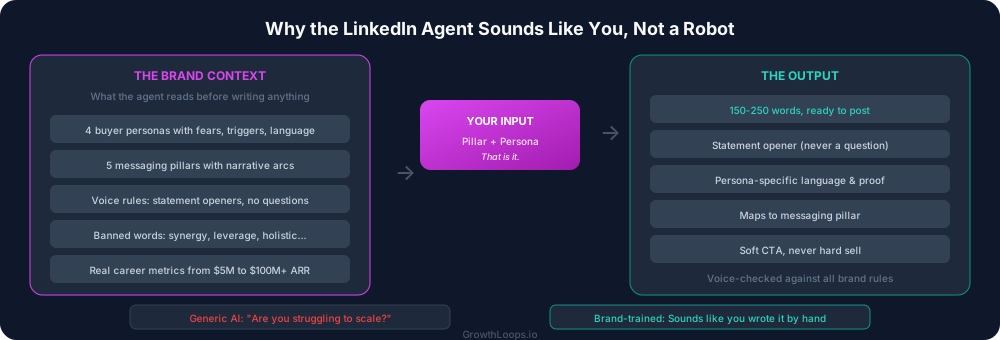
When I built the LinkedIn agent in Claude Code, I did not just give it a prompt that says "write like Laura." I gave it my entire brand operating system.
It knows my personas. The agent knows I am talking to one of four specific buyers. Alex, the overloaded founder-CEO who is still running marketing themselves. Jordan, the burned buyer who has been let down by agencies and wants proof before commitment. Sam, the technical founder who loves systems but treats marketing like a black box. Morgan, the AI-ambitious operator whose pilots have failed and whose board wants ROI. Each persona gets different language, different proof points, different angles.
It knows my pillars. Every post maps to one of five messaging pillars. The agent does not just write about whatever sounds good. It writes content that advances a specific strategic narrative.
It knows my voice rules. Statement openers only. Never start with a question. Never use banned words like synergy, leverage, holistic, thought leader, innovative, or disruptive. Lead with pipeline, not activities. Specificity over platitudes. Soft CTAs, never hard sell.
It knows my career data. When the agent references a metric, it pulls from real numbers. $5M to $20M ARR in 18 months at Holistaplan. 6x LTV to CAC. 140% ARR growth at LeanLaw. Full rebrand driving partnership growth at ApexEdge. These are not made-up stats. They are my actual track record.
How the workflow runs
You give the agent two inputs: a pillar number and a persona.
That is it.
The agent generates a 150 to 250 word LinkedIn post with a statement opener, a clear narrative arc, persona-specific language, and a soft CTA. Every post is checked against the brand voice rules before it outputs.
If you want to go deeper, you can pair it with the content strategist agent first. Give the strategist a topic and it maps it to the right pillar, persona, funnel stage, and angle. Then feed that into the LinkedIn agent for the actual writing.
The whole process takes about 30 seconds. I used to spend 30 to 45 minutes per post. Now I spend that time reviewing and adding a personal touch, which is a much better use of my time than staring at a blank text box.
The difference is in the details
Here is a real example of what this looks like in practice. If I tell the agent to write a Pillar 1 post (You Have Outgrown Founder-Led Growth) for the Alex persona, it does not write something generic about "the challenges of scaling." It writes something specific about the moment a founder realizes they have been the bottleneck in their own marketing for the last 18 months. It references the pattern I have seen across dozens of engagements. It leads with a specific proof point from my career.
Compare that to what you get from a generic AI tool: "Are you struggling to scale your B2B SaaS marketing? Here are five tips for founder-led growth." One sounds like a person who has been in the room. The other sounds like a template.
What this means for your LinkedIn strategy
If you are a B2B SaaS founder or marketing leader, your LinkedIn presence is not optional. It is where your buyers research you before they take a meeting. It is where your credibility gets built or destroyed.
But consistent, high-quality posting requires a system. Not a tool that generates generic content. A system that knows your brand, your audience, and your strategic narrative.
The LinkedIn agent is one of 20 AI agents I have built as part of the GrowthLoops marketing operating system. It works because it is not operating in isolation. It reads the same brand bible, the same persona definitions, and the same voice rules as every other agent in the system.
That consistency is what makes AI-generated content actually work. Not better prompts. Better systems.