How I Built a Social Media Command Center With AI Agents and Zero Code
I wanted to see all my social media performance in one place. Not in six different platform dashboards. Not in a spreadsheet someone updates manually every Monday. One place where I could see what was working, what was not, and where to focus next.
Every social media management platform offers some version of this. Sprout Social. Hootsuite. Buffer. They all have dashboards. They all cost $200 to $500 a month. And they all show you the same surface-level metrics without connecting them to your actual marketing strategy.
I did not want a dashboard that shows me impressions and engagement rates. I wanted a command center that shows me which content categories are driving results, which personas are responding, and which messaging pillars are landing. I wanted strategic intelligence, not vanity metrics.
So I built one with AI agents and Python. No social media management platform required. No monthly subscription. No code that I wrote by hand.
What the social command center does
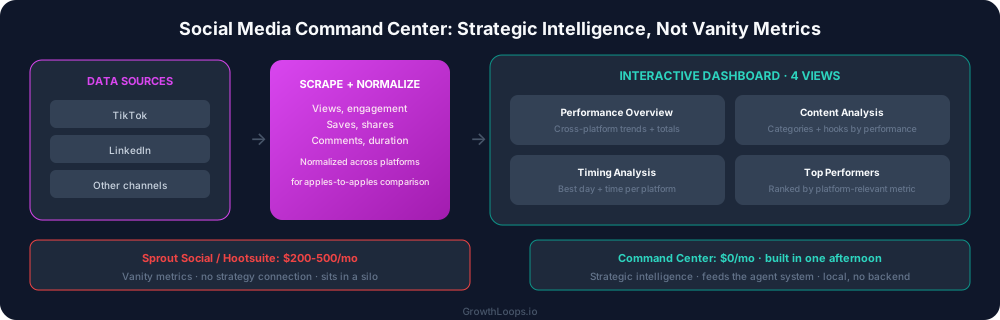
The command center has two components: a scraping system that pulls data from multiple platforms and an interactive dashboard that lets you explore the data.
The scraping system. A Python script that pulls public performance data from TikTok, LinkedIn, and other social channels. It normalizes the data so you can compare across platforms using the same metrics. Views, engagement rate, saves, shares, comments. Everything tagged with the date, platform, and content details.
The dashboard. A local HTML file that runs in your browser. Dark mode. Interactive filters. Sortable tables. Charts that show performance trends over time. You drag in your data file and the dashboard populates instantly.
No backend. No server. No login. It runs entirely on your machine.
Why I built it instead of buying it
Three reasons.
The strategy layer. Off-the-shelf dashboards show you what happened. They do not show you why it happened or what to do about it. My command center connects performance data to content categories, hook styles, and messaging pillars. When I see that educational content is outperforming hot takes on TikTok, I can immediately see if the same pattern holds on LinkedIn. When a specific messaging pillar drives high engagement, I can trace it across every platform and format.
The cost. Social media management platforms charge $200 to $500 per month for dashboard access. That is $2,400 to $6,000 per year for charts I could build myself. The command center cost me nothing beyond the time to build it, which was one afternoon.
The integration with the agent system. The command center feeds data into the rest of the marketing operating system. Performance insights inform the content strategist agent about what topics to prioritize. The TikTok analytics agent reads the same data to find the winners formula. The repurposing engine uses engagement data to decide which content is worth multiplying.
An off-the-shelf dashboard sits in its own silo. The command center is part of the system.
How it was built
I did not write the code. I described what I wanted to Claude Code and it built it.
I said: I want a Python script that scrapes social media performance data and a dark-mode HTML dashboard with filters and charts that I can run locally.
The agent wrote the scraper, the data normalization logic, and the entire dashboard with interactive charts, filters, and sortable tables. I tested it, identified what I wanted changed, and refined the instructions. The whole build took an afternoon.
This is the part that matters. I am not a developer. I do not write Python or JavaScript. But I know exactly what I want a dashboard to show me because I have been running marketing teams for over a decade. The AI agent handles the technical execution. I handle the strategic specification.
That is go-to-market engineering. Not learning to code. Learning to specify what you need precisely enough that AI can build it.
What it shows me
The dashboard has four main views.
Performance overview. Total views, engagement rate, and posting frequency across all platforms. Trend lines showing whether performance is improving or declining. Platform-by-platform comparison.
Content analysis. Performance broken down by content category and hook style. Which topics drive views? Which hooks drive engagement? Which formats drive saves and shares? This is the view I check weekly to make content decisions.
Timing analysis. Performance by day of week and time of day, broken out by platform. The optimal posting window is different for TikTok and LinkedIn. The dashboard shows me exactly when to post on each platform based on my actual data.
Top performers. The top-performing content across all platforms, ranked by the metric that matters most for each platform. For TikTok, that is views. For LinkedIn, that is engagement rate. Each entry links back to the original post so I can study what worked.
What this means for marketing teams
Every marketing team deserves a command center that connects their social performance to their strategy. Most teams settle for platform-native analytics because building a custom dashboard used to require an engineer.
It does not anymore. A marketer who can describe what they want to see can build it in an afternoon using AI tools. The technical barrier is gone.
The implication is bigger than dashboards. Every internal tool your marketing team wishes they had, the reporting dashboard, the competitive tracker, the content calendar with performance data, can now be built by the people who understand the requirement best: the marketers themselves.
That is the shift. Not marketers learning to code. Marketers learning to build.