How I Built an AEO-Optimized Blog Pipeline in One Afternoon
I used to pay an SEO agency $8,000 a month. They were good. They drove real results. But when I started GrowthLoops, that budget did not exist. And the landscape had shifted. SEO was not enough anymore. AI answer engines like Perplexity, ChatGPT, and Google's AI Overviews were becoming the primary way people found information. I needed AEO: Answer Engine Optimization.
AEO is different from traditional SEO in one critical way. Search engines index your page and rank it. AI answer engines read your page and decide whether to cite it as a source in their response. If your content is not structured in a way that AI can parse, you are invisible to the fastest-growing discovery channel in the world.
I built an entire AEO-optimized blog pipeline with Claude Code in a single afternoon. Here is exactly how it works.
The problem with traditional blog setups
Most B2B SaaS websites run on a CMS like WordPress or Webflow. The blog is a feature of the platform. You write in their editor, hit publish, and the CMS handles the rest.
The problem is that these platforms generate JavaScript-heavy pages. When an AI answer engine crawls your blog post, it gets an empty HTML shell that requires JavaScript execution to render the content. Most AI crawlers do not execute JavaScript. They see nothing.
Your blog post could be the most comprehensive answer to a question your buyer is asking, and it is completely invisible to AI answer engines because of how your CMS renders the page.
What I built instead
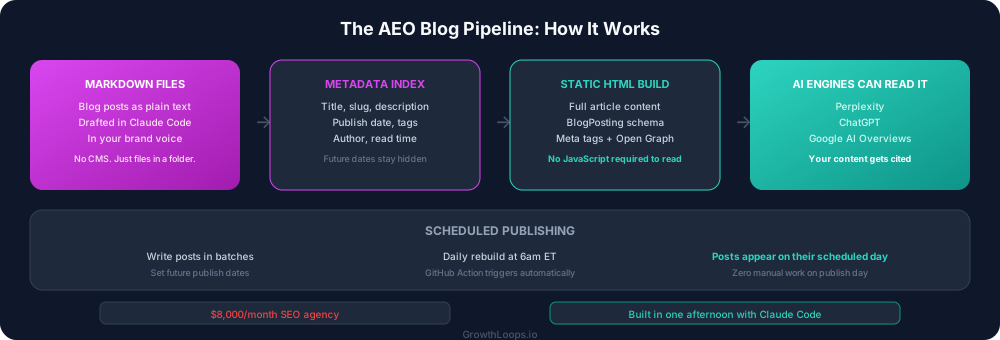
The pipeline has four components.
Markdown files. Every blog post is a plain text file written in markdown. No CMS. No editor. Just a file in a folder. I draft the post in Claude Code, which means the AI agent writes in my voice using my brand bible, and the output is a markdown file ready to go.
A metadata index. A simple file that lists every blog post with its title, slug, description, publish date, tags, and read time. Adding a new post means adding one entry to this list.
A React blog. The website renders the blog using React components. There is a blog listing page that shows all posts and an individual post page that renders the markdown. For human visitors, this works perfectly. Fast, clean, well-designed.
The AEO layer. This is the piece that makes everything work for AI answer engines. After the site builds, a script runs that generates a completely static HTML page for every blog post. No JavaScript required. The full article content, the meta tags, the Open Graph data, and the structured data (BlogPosting schema) are all baked directly into the HTML.
When Perplexity or ChatGPT crawls the page, they get the entire article in clean HTML with structured data that tells them exactly what it is: a blog post, by Laura Beaulieu, published on this date, about this topic, with these keywords.
How scheduled publishing works
I write blog posts in batches. Sometimes ten at a time. Each one gets a future publish date. The pipeline handles the rest.
Posts with future dates are hidden from the blog listing, hidden from individual post pages, and excluded from the pre-rendered static HTML. They are invisible.
Every morning at 6am, a GitHub Action triggers a rebuild. When the rebuild runs, any posts whose date has arrived become visible across the entire system. The blog listing updates. The individual pages activate. The static HTML gets generated with full structured data.
I write once. The pipeline publishes on schedule. No manual work on publish day.
The time comparison
Here is what this pipeline replaced:
Before: Write the post (2-3 hours). Format it in the CMS (30 minutes). Add meta tags manually (15 minutes). Create the featured image (1-2 hours with designer). Publish and check formatting (15 minutes). Repurpose for social (2-4 hours). Total: 6-10 hours per post, spread across multiple days.
After: Draft the post in Claude Code (5-10 minutes, including my review and edits). Add to the index (1 minute). Push to GitHub (1 minute). Repurpose with the content engine (5 minutes). Total: 15-20 minutes per post. The pipeline handles the AEO optimization, the structured data, and the scheduled publishing automatically.
I published 21 blog posts in a single afternoon using this pipeline. Each one with full AEO optimization, structured data, and custom SVG diagrams. That would have been a quarter's worth of content under the old workflow.
Why this matters for your team
Every B2B SaaS marketing team publishes blog content. Most of them are invisible to AI answer engines because of how their CMS renders pages.
The fix is not complicated. It is a build script that generates static HTML. But most marketing teams do not have the engineering resources to build it, and most developers do not understand AEO well enough to build it correctly.
This is exactly the kind of problem that go-to-market engineers solve. A marketer who understands AEO requirements and can use Claude Code to build the pipeline. No engineering team needed. No agency needed. One person, one afternoon, and every blog post you publish from that point forward is optimized for both traditional search and AI answer engines.
The pipeline is infrastructure. You build it once and it works forever. Every post you write automatically gets the AEO treatment. The compounding advantage is significant: while your competitors are still publishing JavaScript-rendered blog posts that AI engines cannot read, every piece of content you create is structured for the discovery channel that is growing fastest.
The $8,000 context
I want to be clear about something. The SEO agency I used to pay $8,000 a month was worth the money at the time. They drove real pipeline. This is not a story about agencies being a waste.
This is a story about capability shifting. What required a specialized agency and a significant budget two years ago can now be built by a single marketer with the right tools in a single afternoon. The capability is not cheaper. It is more accessible. And it is more integrated with your overall marketing operating system because you built it yourself.
That shift is happening across every marketing function. The teams that recognize it and start building will have a structural advantage that is very difficult to compete with.