How I Use an AI Agent to Mine Lenny's Podcast for GTM Insights
Lenny Rachitsky interviews the best operators in SaaS. Product leaders, growth executives, founders who have scaled from zero to hundreds of millions in ARR. Every episode is packed with insights about go-to-market strategy, product-led growth, pricing, positioning, and team building.
The problem is that each episode is 60 to 90 minutes long. Even if you listen to every one, the insights blur together. You remember that someone said something smart about pricing tiers but you cannot find the exact quote. You know there was a great framework for ICP prioritization but it was buried in minute 47 of a conversation about something else entirely.
I wanted a way to systematically extract the GTM insights from these conversations and turn them into actionable intelligence for my work. So I built an AI agent that mines Lenny's podcast transcripts and pulls out exactly what I need.
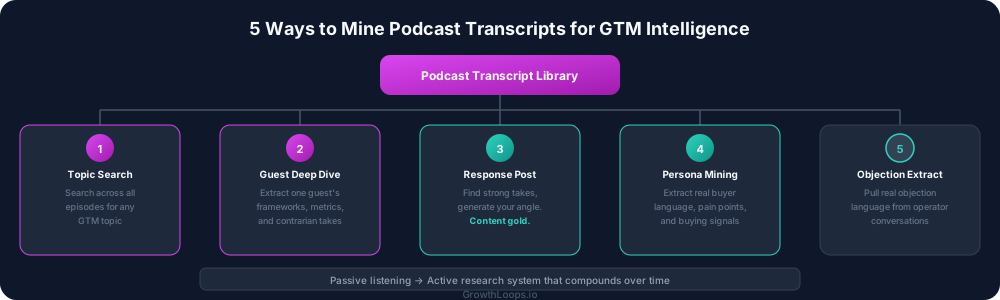
What the Lenny intelligence agent does
The agent supports five different ways to mine the podcast data. Each one is designed for a specific use case.
Topic search. Give the agent a topic like "pricing strategy" or "founder-led sales" and it scans across transcripts to find every relevant insight, framework, and data point. It pulls exact quotes with context so you can see who said it and why. This is how I stay current on what the best operators are thinking about any given GTM challenge.
Guest deep dive. Pick a specific guest and the agent extracts their full knowledge contribution. Their frameworks, their contrarian takes, the specific metrics they shared. This is incredibly useful before a meeting with someone in a similar role or industry. If Lenny interviewed a CMO who scaled a company from $10M to $100M, I want to know exactly what they did and what they learned.
Response post. This is my favorite workflow. The agent finds a strong take from a guest, extracts the quote and context, then generates my alternative perspective on it. Not agreeing. Not disagreeing for the sake of disagreeing. My genuine take based on my experience. This is content gold for LinkedIn because it is specific, it references a known voice, and it adds a new angle to an existing conversation.
Persona mining. The agent scans transcripts for language, pain points, and buying signals that match my target personas. When a founder on the podcast describes their frustration with marketing, that is real buyer language I can use in my messaging. When a VP of Marketing talks about what they wish their CMO understood, that is positioning intelligence. The podcast is full of unfiltered buyer insight if you know how to extract it.
Objection extraction. Guests regularly talk about why they did or did not buy certain services, what made them skeptical of consultants, and what changed their mind. The agent pulls these moments and maps them to my objection library so I can refine my reframes based on real operator language.
Why this is better than just listening
I still listen to the podcast. But listening and systematically mining are two different things.
When I listen, I absorb general impressions. When the agent mines, it extracts structured data. Exact quotes. Specific frameworks. Quantified results. All organized by topic, guest, and relevance to my business.
The agent also does something I cannot do as a listener: it searches across dozens of episodes simultaneously. When I want to understand how the best operators think about category creation, the agent does not just check one episode. It scans the entire library and surfaces every relevant mention, compares the different perspectives, and identifies the consensus and the outliers.
That cross-episode analysis is where the real intelligence lives. One guest's framework becomes more powerful when you can see how three other guests applied a similar approach in different contexts.
How I turn podcast intelligence into content
The response post workflow is a content engine on its own. Every week, I run the agent against recent episodes and it generates three to five potential LinkedIn posts, each one responding to a specific insight from a specific guest with my own take.
These posts consistently outperform my other content because they have built-in credibility. They reference a known voice in the industry. They add a genuine perspective. They are specific enough to be interesting and contrarian enough to drive engagement.
Here is the pattern: guest says something smart about a topic I have experience with. I add context from my career that either supports, challenges, or extends their point. The result is a post that feels like a conversation between two operators, not a generic take on a trending topic.
Where it fits in the system
The Lenny intelligence agent feeds directly into the rest of the marketing operating system. Insights from persona mining go into the brand bible so every other agent gets smarter about buyer language. Response posts go through the quality control agent to check voice compliance. Strong frameworks get fed into the content repurposing engine to multiply across formats.
The podcast is one of the best free sources of GTM intelligence available. The agent turns it from passive listening into an active research system that compounds over time.