How I Version Control My Entire Marketing Operating System With Git
Six months ago, my marketing system lived in a collection of Google Docs, Notion pages, and scattered files on my desktop. The brand bible was in one place. The agent instructions were in another. The blog drafts were in a third. When I updated a persona definition, I had to remember to update it everywhere. I usually forgot.
Today, everything lives in version-controlled Git repositories. Every change is tracked. Every version is recoverable. Every update propagates to every agent automatically because they all read from the same source of truth.
The shift from scattered documents to version-controlled infrastructure changed how my marketing system operates. Here is what I learned.
What version control actually means for marketing
Version control tracks every change to every file over time. When I update my brand bible to add a new banned word, Git records what changed, when it changed, and what the file looked like before the change.
If I add a voice rule that makes my content agent produce worse output, I can see exactly which change caused the problem and revert it. The previous version is not lost. It is stored permanently.
For a marketing operating system where the brand context directly drives agent output, this is essential. A single word change in the persona definition can shift how every agent writes. Without version control, those changes are invisible. With it, they are tracked and reversible.
What I version control
The brand bible (CLAUDE.md). This is the most frequently updated file in the system. Persona refinements, voice rule additions, banned word updates, competitive positioning shifts. Every change matters because every agent reads this file.
Agent skill files. The instructions for every agent in the .claude/commands/ directory. When I refine how the competitive ads agent formats its output, that change is tracked. When I add a new step to the content repurposing workflow, that is tracked too.
Blog content. Every blog post is a markdown file in the repository. The full history of edits is preserved. If I need to update a post six months from now, I can see exactly what it said originally.
Diagrams and visual assets. Every SVG diagram that appears in the blog posts lives in the repository. They are version-controlled alongside the content they illustrate.
Configuration files. The blog metadata index, the build scripts, the pre-rendering configuration. Everything that makes the pipeline work.
What I learned
Lesson 1: The brand bible changes more than you think. In six months, I have made over 50 updates to my CLAUDE.md file. Persona refinements based on real conversations. Voice rules added after catching patterns in agent output. Banned words added after seeing them slip through. Without version control, those 50 iterations would be invisible. I would have no record of what changed or why.
Lesson 2: Agent instructions need iteration history. When an agent starts producing worse output, the question is always "what changed?" Git blame shows me exactly which instruction update caused the regression. I fix it in minutes instead of spending an hour re-reading the entire instruction set trying to spot the problem.
Lesson 3: Branching lets you experiment safely. When I want to try a major change to an agent's workflow, I create a branch. Test the change. If it works, I merge it. If it breaks things, I delete the branch. The main system is never at risk.
Lesson 4: The commit history tells a story. Looking back through my commit messages, I can see the evolution of the entire marketing operating system. First agent built. Brand bible created. QC system added. Orchestrator deployed. Blog pipeline connected. It is a timeline of capability development that would not exist without version control.
The workflow in practice
My daily workflow is simple.
I make changes in Claude Code. Maybe I refine an agent instruction, draft a blog post, or update the brand bible. When I am done, I stage the changes, write a commit message that describes what changed and why, and push to GitHub.
If the changes are to the website repository, pushing triggers an automatic deployment. The site rebuilds. New blog posts go live. Updated content refreshes.
If the changes are to the marketing agents repository, the updated instructions take effect the next time I run the agent. Every team member who pulls the latest version gets the update automatically.
The whole process takes about 30 seconds. Stage, commit, push. The system handles the rest.
Why marketing teams should adopt this now
Most marketing teams manage their marketing assets like it is 2015. Brand guidelines in a PDF. Content calendar in a spreadsheet. Agent instructions in scattered documents. No version history. No collaboration protocol. No deployment automation.
Engineering teams figured out decades ago that version control is not optional for managing complex systems. Your marketing operating system is a complex system. It has components that depend on each other. It changes frequently. It needs to be reliable.
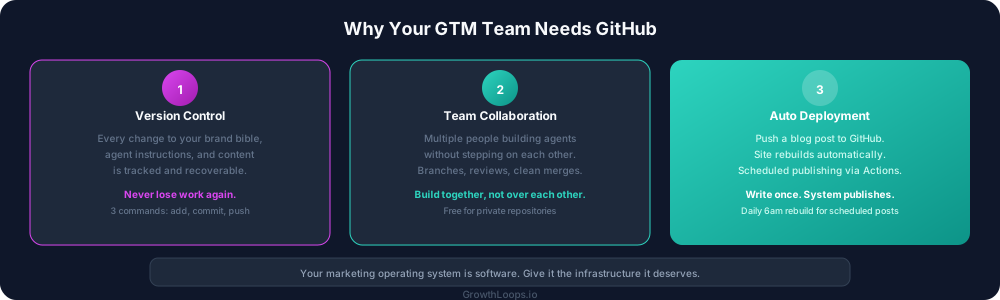
Git is free. GitHub is free for private repositories. The learning curve is three commands. And Claude Code runs those commands for you if you ask it to.
The barrier is not technical. It is the recognition that your marketing system is infrastructure worth managing properly. Once you make that shift, you will never go back to scattered documents and hope-based version management.