How to Train Your Marketing Team to Build Their Own AI Agents
The biggest mistake companies make with AI adoption is treating it as a technology initiative. They buy an enterprise AI license, send a company-wide email about "AI enablement," schedule a lunch-and-learn, and then wonder why nothing changes.
Nothing changes because knowing AI exists is not the same as knowing how to build with it. Telling your marketing team to "use AI more" is like telling them to "use data more." It sounds right. It means nothing. And it produces exactly zero new capabilities.
The companies that are actually pulling ahead right now are doing something different. They are training their existing marketing people to become go-to-market engineers. Not by sending them to a coding bootcamp. By teaching them to build AI agents that handle the repetitive, research-heavy, and execution-intensive parts of their job.
I have done this at my own company and with clients. Here is how it actually works.
Start with the pain, not the technology
The first conversation is never about AI. It is about what is eating your team's time.
Sit down with every person on your marketing team and ask them one question: what do you spend the most time on that you wish you did not have to do?
The answers are always some version of the same things. Competitive research. Content reformatting. Performance reporting. Email personalization. Creative brief writing. QC reviews. These are the tasks that are important enough to do but repetitive enough to dread.
Those tasks are your starting list. Each one is a candidate for an AI agent. You are not looking for the most impressive AI use case. You are looking for the task where the gap between time spent and strategic value is the widest.
Teach the framework, not the tool
The biggest barrier to AI adoption on marketing teams is not technical skill. It is mental model. Most marketers think of AI as a chatbot they type questions into. They do not think of it as a system they can build and train.
The framework I teach is simple:
An AI agent is a team member with a defined role, a system prompt, and a feedback loop.
The role is the job the agent does. "Scan competitor ads across three platforms and identify messaging patterns." That is a role. It is specific. It is bounded. It has clear inputs and outputs.
The system prompt is the knowledge the agent needs to do its job. Your brand voice rules. Your personas. Your positioning. Your banned words. Your metrics. Everything a human team member would need to learn in their first two weeks, codified into a document the agent reads before it executes.
The feedback loop is how the agent gets better. You review the output, identify what was off, and refine the instructions. The agent does not learn on its own. You teach it by tightening the prompt based on what you see.
When your team understands this framework, AI stops being a magic box and starts being a practical tool they can shape to their needs.
The first agent exercise
I run this exercise with every team I train. It takes about two hours and it changes how people think about AI permanently.
Hour one: Define the agent. Pick the task from the pain list. Write down exactly what a perfect version of that task looks like. What are the inputs? What are the outputs? What does good look like? What does bad look like? What rules should never be broken?
This is strategy work, not technical work. A marketer who has been doing competitive research for three years knows exactly what a good competitive analysis looks like. They just never had to write it down as a specification before.
Hour two: Build and test. Open Claude Code. Create a command file with the specification from hour one. Run it. Review the output. Identify what is wrong. Refine the instructions. Run it again. In two hours, most people have a working first version of an agent that handles a task they used to spend a full day on.
The breakthrough moment is always the same. They look at the output from the agent and say "wait, that is actually good." Then they immediately start thinking about what else they could build. That is the moment the mental model shifts.
Scale from one agent to a system
The first agent is the hardest because it requires the mental model shift. Every agent after that is easier because the pattern is established.
Here is the progression I recommend:
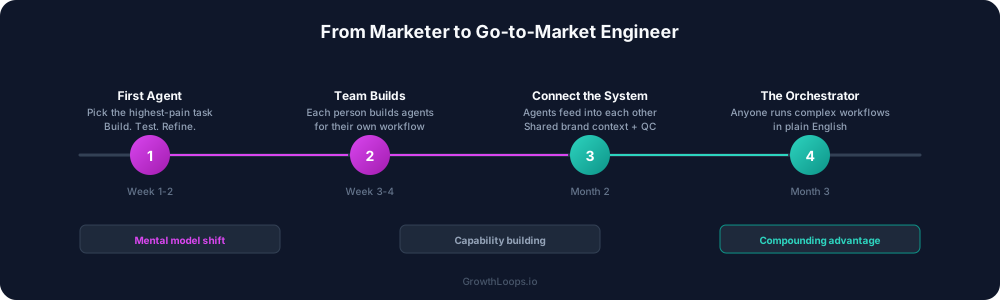
Week 1 to 2: The first agent. Pick the highest-pain, most repetitive task. Build the agent. Use it daily. Refine it based on output quality.
Week 3 to 4: The second and third agents. Each team member builds an agent for their own workflow. The demand gen person builds a competitive intelligence agent. The content marketer builds a repurposing agent. The marketing ops person builds a reporting agent.
Month 2: Connect the agents. Start passing output from one agent as input to another. The competitive intelligence agent's output feeds the content agent. The content agent's output feeds the QC agent. Now you have a system, not a collection of tools.
Month 3: The orchestrator. Build a master agent that coordinates the others. Now anyone on the team can run complex multi-agent workflows by describing what they need in plain English.
This progression works because it builds confidence incrementally. Nobody goes from "I have never used AI" to "I am running a 20-agent marketing operating system" in a week. But they can get there in three months if each step builds on the last.
What changes when your team can build
The shift is not just about efficiency. It is about capability.
A marketing team that can build AI agents does not need to wait for engineering to build internal tools. They build their own. They do not need to hire an agency for competitive research. They build an agent that does it better. They do not need to add headcount to increase content output. They build a repurposing engine that multiplies everything they create.
The team becomes self-sufficient in a way that was not possible before. They identify a problem, spec the solution, build the agent, and deploy it. The cycle time from "I wish we had a tool for this" to "we have a tool for this" drops from months to hours.
That is what go-to-market engineering looks like in practice. Not a new title. Not a new hire. A new capability embedded in your existing team.
The most common objection
"My team is not technical enough for this."
I hear this from every marketing leader before they see their team do it. And it is wrong every single time.
Building AI agents in Claude Code does not require coding. It requires clear thinking. It requires being able to describe what good looks like. It requires understanding your brand, your audience, and your workflows well enough to write them down.
Those are marketing skills. Your team already has them. They just have not applied them to building tools before.
The technical barrier is gone. The only barrier left is the decision to start.