How to Write a Brand Bible That Makes AI Sound Like You
The number one complaint I hear about AI-generated marketing content is "it does not sound like us." And every time, the problem is the same. The company has no brand bible. Or they have a brand bible that lives in a Google Doc nobody has opened since the agency delivered it two years ago.
When there is no brand context for AI to read, it defaults to generic. It writes in the same voice it uses for everyone: professional, vague, full of words like "innovative" and "seamless" and "leverage." It sounds like AI because you gave it nothing else to sound like.
The fix is not better prompts. The fix is a better foundation. A brand bible that AI reads every single time it generates anything for your company. In Claude Code, this file is called CLAUDE.md. It lives in your project root. Every agent, every command, every workflow reads it automatically.
Here is how to write one that actually works.
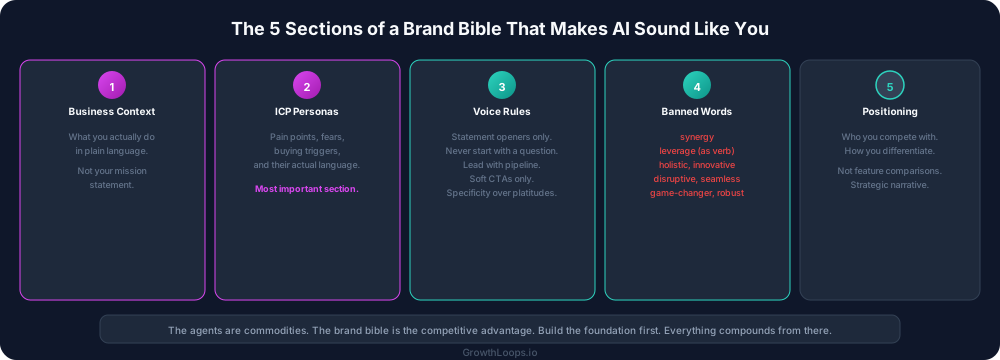
What goes in the brand bible
The brand bible has five sections. Each one gives AI a specific type of context that prevents the generic output problem.
Section 1: Business context. One to two sentences about what you do and who you serve. Not your mission statement. What you actually do in language a real person would use. "We build tax planning software for financial advisors" is useful. "We empower financial professionals to unlock their potential" is not.
Section 2: ICP personas. Two to four buyer personas. Not demographic profiles. Behavioral profiles. For each persona, include their title, their company size, their specific pain points (not generic ones), their buying triggers, their fears, and what they actually want.
The persona section is the most important section in the entire document. When AI knows exactly who it is talking to, it writes differently. A post targeting a technical founder who loves systems reads completely differently from a post targeting a burned buyer who just fired their last agency. That difference only happens when the personas are specific enough.
Section 3: Brand voice rules. This is where you define how your brand sounds. Three to five adjectives that describe your tone. Direct or conversational? Data-driven or story-driven? Formal or casual?
Then the specific rules. These are the constraints that make your voice yours:
- How to open content (statement openers only, never questions, never "In today's fast-paced...")
- What point of view to write in
- How long content should be by format
- What kind of CTAs to use (soft only, never hard sell)
- Whether to use specific metrics or general claims
Section 4: Banned words. This is the section people skip and then complain about generic output. List every word and phrase that should never appear in your marketing. Be exhaustive.
My list includes: synergy, leverage (as a verb), holistic, thought leader, innovative, disruptive, seamless, robust, cutting-edge, game-changer, best-in-class, growth hacking, unlock, empower, supercharge, and about 20 more.
Every one of these words signals "AI wrote this" or "marketing team phoned it in." When you ban them, the AI has to work harder to be specific. And specific is what sounds human.
Section 5: Competitive positioning. Who you compete with and how you differentiate. Not a feature comparison. A positioning statement for each competitor category that your agents can reference when they need to make a competitive point.
The rules that make the biggest difference
After building brand bibles for my own company and for clients, here are the rules that have the highest impact on output quality:
Specificity over platitudes. Add a rule that says "never make a claim without a specific metric, example, or proof point." This single rule eliminates 80% of generic AI output. Instead of "we help companies grow," the agent writes "we scaled pipeline 140% in 18 months at LeanLaw."
No filler intros. Ban opening sentences that do not contain information. "In today's competitive landscape" contains zero information. "Most B2B SaaS companies between $5M and $50M ARR are stuck in the same trap" contains specific context that sets up the rest of the piece.
Lead with pipeline, not activities. If your company sells to business buyers, every piece of content should connect back to revenue. "We ran 70 webinars" is an activity. "Webinars drove $1M in pipeline" is a result. The AI follows whatever pattern you set.
Soft CTAs only. "Book a demo now" sounds desperate. "If you are a B2B SaaS founder scaling past $10M ARR, this is the conversation worth having" sounds confident. Define what your CTAs should feel like and the agent will match it every time.
How to test your brand bible
Write the brand bible. Then run the simplest possible test.
Ask Claude Code to write a LinkedIn post using only the brand bible for context. Do not give it any other instructions. Just a topic.
Read the output. Does it sound like you? Does it sound like something you would actually post? Are the banned words absent? Is the persona targeting visible? Is there a specific metric or proof point?
If yes, the brand bible is working. If no, the sections that need tightening are usually obvious. The voice is too vague. The personas are not specific enough. The banned words list is too short.
Tighten. Test again. By the third iteration, you will have a brand bible that produces output you would put your name on.
Why this matters beyond content
The brand bible does not just affect blog posts and LinkedIn content. It affects every agent in your system.
Your competitive ads agent reads the brand bible and analyzes competitors through the lens of your positioning. Your objection coach reads it and frames reframes using your voice and your proof points. Your email agent reads it and writes outbound that sounds like a person, not a template.
The brand bible is the institutional knowledge layer of your entire marketing operating system. Without it, you have a collection of generic AI tools. With it, you have a system that sounds like your brand on every output, in every format, for every persona.
Write it once. Refine it continuously. Everything else gets better because of it.