I Open-Sourced My Marketing Agents. Here Is What Happened.
I built 20 AI marketing agents over the course of a few months. They run my competitive intelligence, write my content, handle my outbound email, produce creative briefs, and quality-check everything before it goes out the door. They are the backbone of my marketing operation at GrowthLoops.
Then I open-sourced three of them and put them on GitHub for anyone to use.
People thought I was crazy. Why would you give away the tools that power your business? Why would you let competitors use the same system you use?
Here is why, and here is what actually happened.
Why I open-sourced
Three reasons.
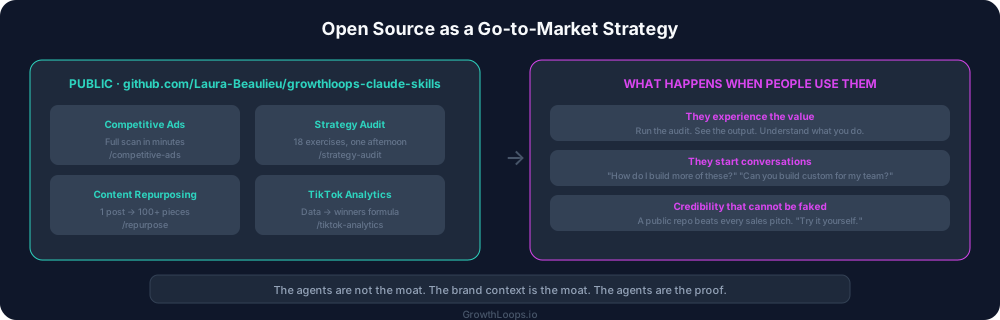
Reason one: the agents are not the moat. The agents are powerful, but they are only as good as the brand context they read. My competitive ads agent running against my CLAUDE.md file produces output tuned to my personas, my voice, and my positioning. The same agent running against someone else's brand context produces output tuned to their business. The agent is a capability. The brand context is the moat.
Reason two: it is the best proof point possible. I can tell people I build AI marketing agents. Or I can let them try one. When a founder runs the strategy audit agent against their own company and gets back an 18-exercise marketing strategy document in an afternoon, they understand what I do better than any sales pitch could explain.
Reason three: the market needs to see this is real. Most people still think AI marketing means "use ChatGPT to write a blog post." The open-source agents show what is actually possible when you build a system, not just write prompts. Every person who uses the agents and sees the quality of the output becomes someone who understands the future of go-to-market.
What I open-sourced
Three agents from the GrowthLoops system, adapted to be brand-agnostic so any B2B SaaS team can use them:
The competitive ads intelligence agent. Scans Meta, LinkedIn, and Google ad libraries for any set of competitors. Extracts messaging patterns, creative strategies, and positioning gaps. Produces a full competitive analysis with screenshots saved to an output folder.
The marketing strategy audit. The same 18-exercise framework I run as a fractional CMO. Company overview, ICP prioritization, positioning, revenue levers, channel strategy, team evaluation, AI readiness. The full deliverable that consulting firms charge five figures for.
The content repurposing engine. Takes one piece of content and multiplies it across 10 narrative angles, 11 output formats, and multiple personas. Not reformatting. Strategic repurposing where every piece is tailored to a specific buyer.
Plus a TikTok analytics agent that scrapes any profile, categorizes videos by topic and hook style, finds the winners formula, and generates an interactive dashboard.
All available at github.com/Laura-Beaulieu/growthloops-claude-skills.
What happened after launch
The response surprised me in ways I did not expect.
People actually used them. Not just starred the repo. Cloned it, filled in their CLAUDE.md, and ran the agents against their own businesses. I started getting messages from founders who ran the strategy audit and said it surfaced gaps their team had been ignoring for months.
It started conversations. Every person who used the agents had follow-up questions. How do I build more of these? Can you build custom agents for my team? How do I connect these to my existing marketing workflows? The open-source agents became the top of my sales funnel without me intending them to be.
It established credibility faster than any content could. When I say I build AI marketing agents, people nod politely. When they use one and see the output, they lean in. The gap between "that sounds interesting" and "I need this for my team" closes the moment they run the agent themselves.
Competitors did not suddenly replicate my business. This was the fear people raised. In practice, nobody took the agents and built a competing consulting practice. Because the agents without the strategic judgment about how to use them are just tools. The value is in knowing which agent to run, when, and how to interpret the output. That is what clients pay for.
What I learned about open source as a go-to-market strategy
Open-sourcing is not giving away your business. It is showing your work. It is the most powerful trust signal you can send in a market full of people who claim capabilities they do not have.
In B2B SaaS marketing specifically, where every consultant and agency claims to be "AI-powered" now, the ability to point to a public repo and say "here, try it yourself" is a differentiation that cannot be faked.
The pattern I would recommend to any consultant or agency: build your system. Open-source the parts that demonstrate capability. Keep the brand context and strategic layer as your client deliverable. Let the open-source work do your marketing for you.
What is coming next
I am continuing to convert more agents from the private system into public, brand-agnostic versions. The next candidates are the TikTok script generator, the objection coach, the LinkedIn intelligence monitor, and the visual marketing agent.
Each one that goes public expands the proof point. And each one generates conversations with exactly the kind of companies I want to work with: B2B SaaS teams that understand the shift to AI-powered go-to-market and want to build their own operating system.
The repo is open. The agents are free. The system that makes them transformative is what I build with clients.