I Replaced a $15K Strategy Consultant With an 18-Exercise AI Marketing Audit
When I start a new fractional CMO engagement, the first thing I do is run a full marketing strategy build. It covers everything: ICP prioritization, positioning, revenue levers, channel strategy, brand voice, team gaps, and AI readiness. Eighteen exercises across four sections. It is the foundation that every other decision gets built on.
That deliverable used to take me two to three weeks. Interviews, research, analysis, writing. If you hired a consulting firm to do it, you would pay $15,000 to $25,000 and wait six to eight weeks for a deck that collects dust in a shared drive.
I built an AI agent that produces the same deliverable in an afternoon.
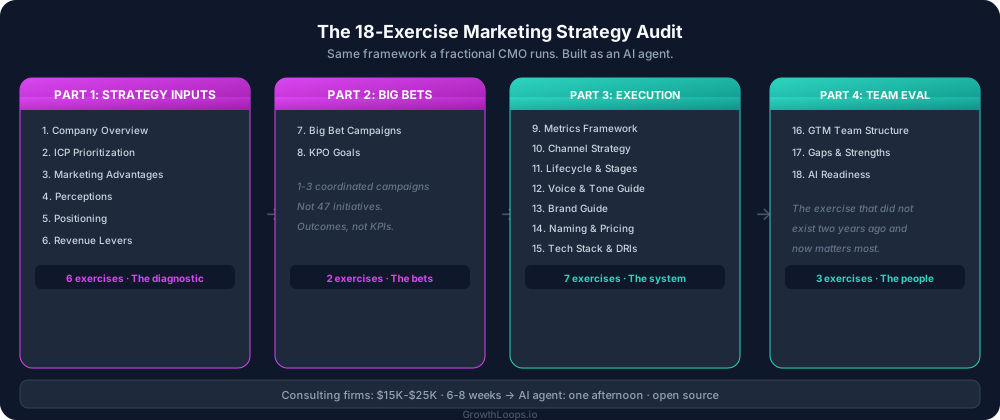
What the strategy audit covers
This is not a surface-level SWOT analysis. It is the exact same framework I use when I walk into a B2B SaaS company as a fractional CMO. Eighteen exercises, four sections, each one building on the last.
Part 1: Strategy Inputs (6 exercises)
This is the diagnostic. The agent researches your company, your market, and your competitors, then works through:
Company overview. Business context, current GTM motion, competitive landscape. Not what your website says. What is actually happening.
ICP prioritization. Not just "who do we sell to" but a segmented breakdown by company type and buyer role, with maturity levels for each. Most companies I work with think they have one ICP. They usually have three or four, and they are treating them all the same.
Marketing advantages. What you actually have going for you. Product advantages, ecosystem advantages, fuel advantages (content, data, community), and engine advantages (team, process, tech). Most teams undercount their advantages because they are too close to them.
Perceptions. The three to five beliefs your market needs to hold about you for your positioning to work. This is the exercise most strategy consultants skip, and it is the one that matters the most. If your market does not believe the right things about you, no amount of demand gen will fix it.
Positioning. Where you are today versus where you need to be in 12 months, mapped in a two-column table. Not aspirational brand statements. Specific, measurable shifts in how the market sees you.
Revenue levers. Stack-ranked by impact: grow top-of-funnel from your core, expand to a new audience, drive expansion revenue, or improve efficiency. Most teams try to pull all four at once. The audit forces you to pick.
Part 2: Big Bets and Goals (2 exercises)
Big bet campaigns. One to three coordinated campaigns with specific channels and content needs. Not a list of 47 initiatives. One to three bets that move the needle.
KPO goals. Key Performance Outcomes for the next 90 days. Not KPIs. Outcomes. The difference matters. A KPI says "increase MQLs by 20%." A KPO says "generate $500K in qualified pipeline from the mid-market segment."
Part 3: Execution Framework (7 exercises)
This is where strategy becomes a system. The agent builds out:
Metrics framework. What you measure weekly, monthly, and quarterly. Not vanity metrics. The numbers that tell you if your strategy is working.
Channel strategy. Investment level, funnel role, and maturity status for every channel. This is where most teams realize they are spreading budget across too many channels and going deep on none.
Lifecycle and account stages. How a lead becomes an opportunity becomes a customer. Most B2B SaaS companies have this partially built in their CRM and partially living in someone's head. The audit makes it explicit.
Voice, tone, and style guide. Brand voice rules, tone variations by context, and specific guidelines that keep every piece of content on brand.
Brand guide summary. Visual and naming conventions so your team stops reinventing the wheel every time they create an asset.
Naming and pricing. Product names, tier structure, and pricing communication rules. How you talk about what you sell.
Tech stack and DRIs. Every marketing tool, who owns it, and whether it is actually integrated or just sitting there collecting license fees.
Part 4: Team Evaluation (3 exercises)
GTM team structure. The org chart as it actually exists, not the one on the slide deck.
Team gaps and strengths. An honest assessment by function. Where you are strong, where you are held together with duct tape.
AI readiness assessment. How prepared your team is to work with AI agents. This is the exercise that did not exist two years ago and now might be the most important one in the entire audit.
Why an AI agent can do this
The strategy audit works as an AI agent because the framework is structured and repeatable. Every engagement I have ever run follows the same 18 exercises in the same order. The judgment calls are real, but they are informed by patterns I have seen across dozens of companies.
When I built this agent in Claude Code, I encoded those patterns. The agent knows what good ICP prioritization looks like for a $10M ARR B2B SaaS company. It knows what a healthy channel mix looks like versus one that is spread too thin. It knows the difference between a positioning statement that sounds good in a boardroom and one that actually changes buyer behavior.
The agent also researches. It does not just work from what you tell it. It searches for your company, your competitors, your market context. It pulls real data to inform its recommendations.
What it does not replace
I want to be direct about this. The AI strategy audit does not replace the conversations. It does not replace sitting in a room with a founder and hearing the real story behind why their last marketing hire did not work out. It does not replace the judgment call about whether a company should bet on partnerships or paid media based on the CEO's risk tolerance.
What it does replace is the two to three weeks of research, analysis, and document creation that used to happen between those conversations. It compresses the deliverable so you can spend your time on the decisions, not the documentation.
Try it yourself
This agent is open source. You can run it today using Claude Code.
The repo is at github.com/Laura-Beaulieu/growthloops-claude-skills. Clone it, fill in your company details in the CLAUDE.md file, and run /strategy-audit with your company name, website, and ARR.
You will get a complete marketing strategy foundation document. The same one that consulting firms charge five figures to produce.
What comes after the audit
The strategy audit is the starting point. Once you have the foundation, every other AI agent in the system can read it. Your content agents know your positioning. Your competitive intelligence agent knows your market. Your email agents know your personas and their objections.
That is the difference between using AI as a tool and building AI into your go-to-market operating system. The audit creates the context. The agents use it. Everything compounds from there.
If you are a B2B SaaS founder or marketing leader who has been meaning to get a real strategy in place but keeps pushing it because of the time and cost, this is your shortcut. Not a shortcut on quality. A shortcut on the busy work that sits between you and clarity.