The Marketing AI Maturity Curve: From Prompting ChatGPT to Building Agents
Most marketing teams think they have adopted AI. They have a ChatGPT tab open. Someone uses it to draft emails. The intern cleans up subject lines with it. That counts as "we use AI" in the standup, and everyone moves on.
It is not the same thing as building with AI. And that difference is about to separate marketing teams in a way that is hard to reverse.
There is a maturity curve here. Three stages. Most teams sit at the bottom of it and assume they are further along than they are. The advantage lives at the top, where almost no one has reached yet.
What are the stages of AI adoption for marketing teams?
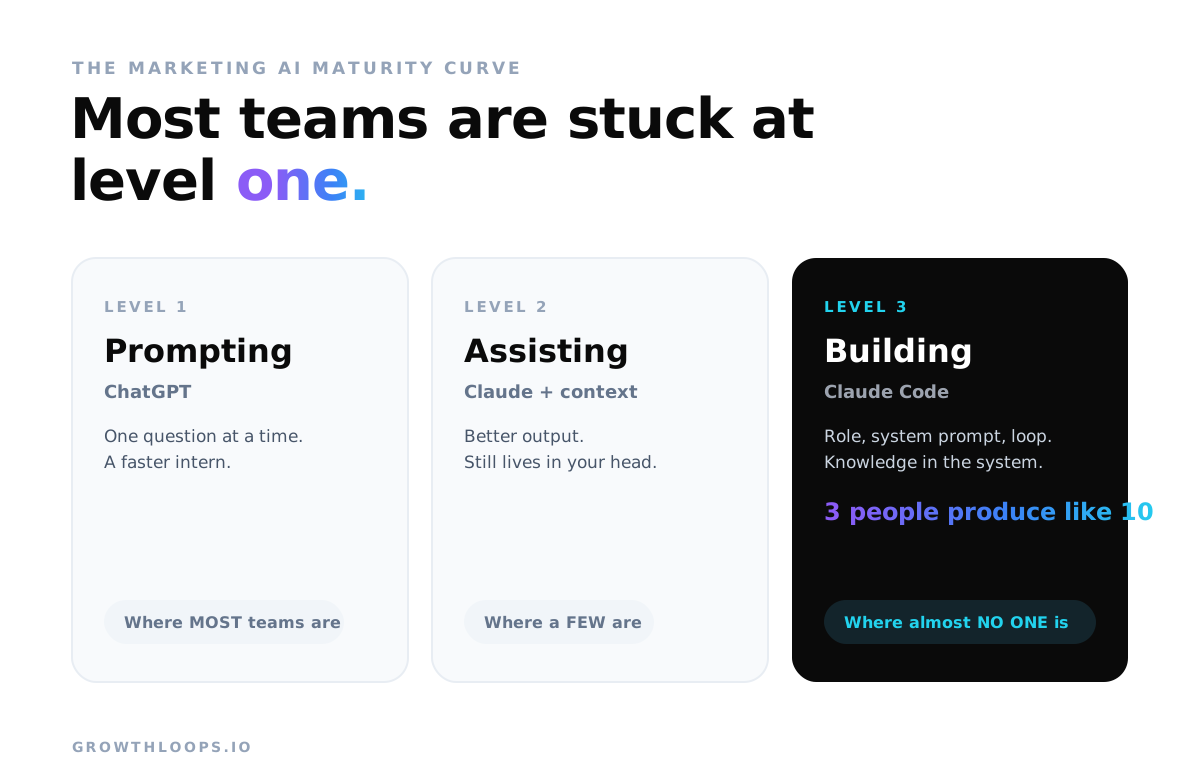
There are three stages, and they are not about how much AI you use. They are about how you use it.
Level 1: Prompting. You type requests into a chat assistant like ChatGPT and copy the answers out by hand. AI is a faster intern. Every task starts from a blank box.
Level 2: Deliberate assisting. You work inside a capable assistant like Claude with real context. You give it your brand voice, your ICP, your past work. The output gets sharper because the inputs do.
Level 3: Building. You build agents in Claude Code. Each agent has a defined role, a system prompt, and a feedback loop. The work runs without you retyping the instructions every time.
Level 1 is where most teams are. Level 2 is where a few thoughtful ones are. Level 3 is where almost no one is, which is exactly why it is the advantage.
What does Level 1 (prompting ChatGPT) actually look like?
Level 1 is one human, one chat box, one task at a time.
ChatGPT is a chat assistant. You prompt it, it answers, you copy the answer somewhere useful. Nothing persists. Tomorrow you paste your brand guidelines in again. Next week you re-explain your ICP to it for the fifth time.
The output is generic because the input is generic. The model does not know your positioning, your competitors, or the difference between how you talk to Morgan and how you talk to a founder. So it gives you something that sounds like everyone else's marketing.
Level 1 saves a few minutes per task. It does not change what your team can produce. You are still the bottleneck, just a slightly faster one.
Why do marketing teams get stuck at Level 1?
Teams get stuck because Level 1 works just well enough to feel like progress.
The draft email is faster. The blog outline appears in seconds. It feels like adoption, so the urgency to go further evaporates. That false summit is the trap.
The deeper reason is that no one redesigned the work. They bolted a chat box onto the existing process. The marketer still owns every task start to finish. AI just shaved time off the typing. When you treat AI as a tool instead of a team member, you cap the upside at "slightly faster human."
This is the same reason most AI pilots stall in week three. The team ran a tool experiment, not a team redesign. A tool has no role. An agent does.
How is Level 2 (working in Claude deliberately) different?
Level 2 is the same chat interface used with intent.
Claude is a chat assistant too, but at Level 2 you stop treating it like a vending machine. You feed it real context. Your brand voice rules. Your ICP definitions. Examples of work you are proud of. You give it the strategy behind the ask, not just the ask.
The output quality jumps because you closed the input gap. The model now writes for your buyer, in your voice, against your competitors. You are still copying answers out by hand, but the answers are worth copying.
Level 2 is a real upgrade. It is also still capped, because the context lives in your head and you rebuild it every session. The knowledge does not compound. You do.
What does Level 3 (building agents in Claude Code) look like?
Level 3 is where the work stops depending on you typing the same instructions over and over.
Claude Code is the environment where you build agents. An agent is not a chat. It is a defined worker. Three things make it an agent instead of a prompt:
A role. This agent writes blog posts. That one runs competitive intelligence. Another handles outbound sequences. Each has one job and does it the same way every time.
A system prompt. The persistent instructions that hold the agent's context. Your brand voice, your ICP, your banned words, your standards. You write it once. The agent reads it every single time. You never re-explain yourself again.
A feedback loop. A way to check the output against a standard and improve it. A QC agent reviews what the content agent produced. The work gets graded, corrected, and sharpened without a human catching every error by hand.
At Level 3 the institutional knowledge lives in the system, not in someone's head. A three-person team starts producing like a team of ten, because the agents handle the predictable, recurring work and the humans make the decisions that move the number.
I run my own marketing this way. 45 production agents handle content, competitive intel, outbound, and QC. I am not describing a vision. I am describing a Tuesday.
How do you climb from prompting to building?
You climb one rung at a time, and faster than you think.
From Level 1 to Level 2, stop starting cold. Build a context document with your brand voice, your ICP, and three examples of great work. Paste it in before every ask. Your output quality jumps the same day.
From Level 2 to Level 3, pick one recurring workflow that eats your week. Repurposing. Competitive research. First-draft blog posts. Build a single agent for it in Claude Code with a role and a system prompt. One agent that works convinces a team faster than any demo.
Then add a second agent. Then a feedback loop between them. The system compounds from there. The brand context gets more refined every month. The agents get more accurate. The advantage widens while late movers are still pasting guidelines into a chat box.
Why the gap between prompting and building decides the next two years
"We use AI" and "we build with AI" are not the same sentence, and the market is about to make that obvious.
Teams at Level 1 get a faster intern. Teams at Level 3 get an operating system. One saves minutes. The other changes what the team can produce and how few people it takes to produce it. That is not a small edge. It is a step function, and it compounds.
The teams climbing to Level 3 right now are building a lead that late movers cannot close quickly. The technology is ready. The frameworks exist. The only variable is when your team decides to stop prompting and start building.
If you want to see what climbing from Level 1 to Level 3 looks like for a team like yours, that is exactly what I teach. Come find me and I will show you the first agent to build.