Prompt Engineering Is Dead. System Engineering Is What Matters Now.
Prompt engineering had its moment. For about 18 months, the most valuable AI skill was knowing how to write a good prompt. People built entire careers around it. Courses, certifications, consulting practices. All focused on the art of asking ChatGPT the right question in the right way.
That moment is over.
Not because prompts do not matter. They do. But because the ceiling on what a single prompt can accomplish has been reached. No matter how perfect your prompt is, you are still one person typing into a chatbot, getting one answer, one time, with no memory and no system behind it.
The marketers who are pulling ahead right now are not writing better prompts. They are building better systems.
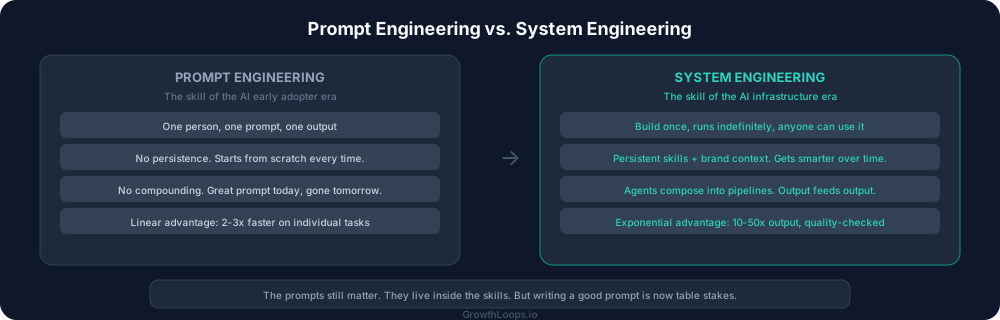
What prompt engineering actually was
Prompt engineering was the skill of crafting input to get better output from a language model. Add context. Be specific. Use examples. Structure your request. Tell the AI what role to play.
These techniques work. They produce noticeably better output than a vague request. And for simple, one-off tasks, they are still useful.
But they have three fundamental limitations.
No persistence. Every prompt starts from scratch. The AI does not remember your brand, your personas, or the last 50 prompts you gave it. You re-explain your context every single time.
No compounding. A great prompt produces great output once. Tomorrow, you start over. The effort you put into crafting the prompt does not make the next prompt better. There is no accumulation of value.
No scale. Prompt engineering is a one-to-one activity. One person, one prompt, one output. If you need 24 pieces of content from a single blog post, you write 24 prompts. If you need a competitive scan every week, you write the same prompt every week.
What system engineering looks like
System engineering is building AI infrastructure that runs without re-explanation, compounds over time, and scales beyond one person.
Here is the difference in practice.
Prompt engineering approach to competitive intelligence: Open ChatGPT. Type "Analyze the competitive landscape for B2B SaaS marketing tools. Focus on messaging patterns, positioning, and gaps." Get a generic response based on training data. Try again next week with a slightly different prompt.
System engineering approach to competitive intelligence: Build an agent with instructions to scan Meta Ad Library, LinkedIn Ad Library, and Google Ads Transparency Center. Connect it to the Playwright browser tool so it pulls live data. Give it your brand context so it filters results through your positioning. Run it whenever you want. Get real-time intelligence tailored to your market. The agent exists permanently. It gets better every time you refine the instructions. Anyone on your team can run it.
The first approach gives you an answer. The second approach gives you a capability.
The three shifts
Shift 1: From prompts to skills. Instead of typing instructions every time, you write them once as a skill file. The skill lives in your project. It reads your brand context automatically. You run it with a slash command. The instructions are permanent, refined over time, and accessible to your entire team.
Shift 2: From single outputs to pipelines. Instead of getting one piece of content at a time, you build pipelines where agents feed into each other. A competitive scan feeds a content agent. The content agent feeds a repurposing engine. The repurposing engine feeds a QC system. One trigger produces 24 quality-checked, persona-targeted pieces of content.
Shift 3: From individual effort to team capability. Instead of one person who is good at prompting, you have a system that anyone can use. The junior marketer who started last week runs the same workflows as the CMO who built the system. The output quality does not depend on who is running it because the quality is built into the system.
Why this matters right now
The gap between prompt engineers and system engineers is growing exponentially.
A prompt engineer produces better one-off outputs than someone who types vague requests into ChatGPT. That is a linear advantage. They are 2x to 3x more productive on individual tasks.
A system engineer builds infrastructure that produces output at 10x to 50x the volume and consistency, with quality controls built in, accessible to their entire team, compounding over time. That is an exponential advantage.
The prompt engineer writes a LinkedIn post in 5 minutes instead of 30. The system engineer builds a system that produces 24 LinkedIn posts in 5 minutes, all persona-targeted and QC-checked, and it runs the same way next week and the week after.
One person got faster. The other person built a machine.
How to make the shift
If you are currently a prompt engineer (even if you do not call yourself that), here is how to level up.
Step 1: Write your prompts down. Take the prompts you use repeatedly and save them as skill files. This is the simplest version of system engineering. Instead of typing the same instructions every time, you run a command.
Step 2: Add your brand context. Create a CLAUDE.md file with your personas, voice rules, and positioning. Now every skill reads this context automatically. You never re-explain your brand again.
Step 3: Connect the skills. Look at your workflows. Where does the output of one skill become the input of another? Connect them. Build the pipeline.
Step 4: Add quality control. Build a QC skill that checks every output against your brand rules. Now the system maintains quality without human review on every piece.
Step 5: Build the orchestrator. Once you have multiple connected skills, build an orchestrator that lets anyone run complex workflows by describing what they need in plain English.
You just went from prompt engineer to system engineer. The skills are the same. The thinking is different. And the results compound.
The bottom line
Prompt engineering was the skill of the AI early adopter era. System engineering is the skill of the AI infrastructure era. The first era was about getting better output from a chatbot. This era is about building marketing operating systems that run continuously, compound over time, and scale across your team.
The prompts still matter. They live inside the skills. But the skill of writing a good prompt is now table stakes. The skill that differentiates is building the system around it.