The $8,000 SEO Agency vs. $100 a Month: What Changed
I paid an SEO agency $8,000 a month for over a year. They were good. Not "here is a report with vanity metrics" good. Real, measurable, pipeline-driving good. They understood our ICP, they built content around the right keywords, and they drove organic traffic that converted into qualified leads.
I am not going to tell you they were a waste of money. They were not. At the time, they were the right investment for the stage of company I was at and the capabilities my team had.
But what they delivered for $8,000 a month, I now build myself for about $100 a month using Claude Code. Not because the technology replaced the skill. Because the technology gave me the ability to execute on the skill I already had.
That distinction matters. And it is the reason I think the entire SEO and content agency model is about to get restructured.
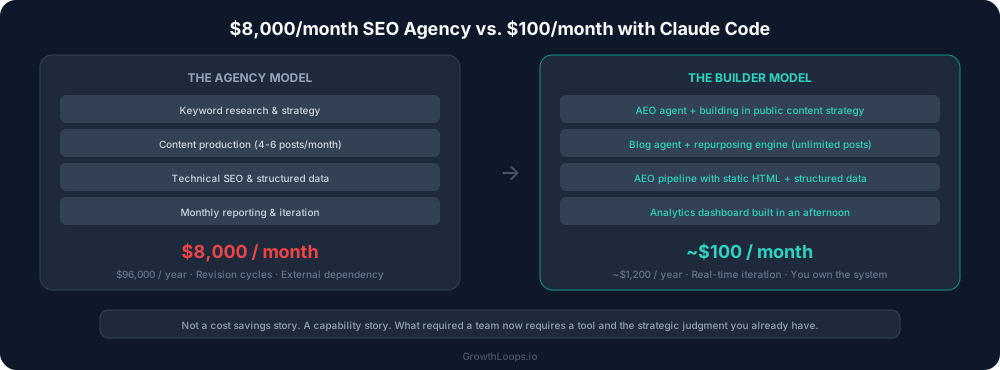
What the agency actually did
Let me break down what $8,000 a month bought, because most people underestimate the work that goes into good SEO.
Keyword research and strategy. Mapping the keywords our ICP was searching, identifying gaps in our content, and prioritizing which topics to pursue based on search volume, difficulty, and buyer intent.
Content production. Writing blog posts optimized for those keywords. Not keyword-stuffed garbage. Well-researched, genuinely useful content that answered the questions our buyers were asking.
Technical SEO. Site speed optimization, structured data, meta tags, internal linking, crawl budget management. The behind-the-scenes work that most marketing teams never think about until it breaks.
Reporting and iteration. Monthly performance reports. Keyword ranking tracking. Content refresh recommendations based on what was declining. This is the ongoing optimization work that separates good agencies from ones that just produce content and hope.
All of that is legitimate, skilled work. It took a team of people to execute. And it produced results.
What I build now for $100 a month
Here is what replaced each of those functions.
Keyword research and strategy is now handled by conversations with Claude Code where I describe my ICP, their pain points, and what they are searching for. The output is a content strategy mapped to buyer intent that is at least as good as what the agency produced. Often better, because I bring 15 years of marketing context to the conversation and the agency was working from a brief.
Content production is handled by my blog agent and the content repurposing engine. I draft a blog post in Claude Code in 5 to 10 minutes. The agent writes in my voice, references my career data, and targets the specific persona I am writing for. I review, edit, and publish. The repurposing engine turns that post into LinkedIn content, email sequences, and social assets.
Technical SEO and AEO is handled by the blog publishing pipeline I built. Every post gets static HTML with structured data, meta tags, and Open Graph data baked in. The pre-rendering ensures AI answer engines can read the content without JavaScript. I built the entire pipeline in one afternoon and it runs automatically on every publish.
Reporting and iteration is handled by my analytics agents and the social media command center. Performance data from multiple platforms, normalized and presented in a dashboard I built myself. No monthly report to wait for. The data is available whenever I want it.
The total cost: my Claude API usage runs about $100 to $150 a month.
What actually changed
The shift is not that AI got better at SEO. The shift is that the execution layer between "know what to do" and "get it done" collapsed.
When I was paying the agency, I was paying for execution. I knew what content we needed. I knew which keywords mattered. I knew how to structure content for search. But I did not have the bandwidth to produce four to six optimized blog posts per month while running the rest of the marketing operation.
The agency was the execution layer. They took my strategic direction and produced the content.
Claude Code is now the execution layer. It takes my strategic direction and produces the content. But faster, cheaper, more consistently on brand, and with the ability to iterate in real time instead of waiting for a revision cycle.
What this means for agencies
I want to be careful here because I have friends who run agencies and I respect the work they do.
The agencies that will thrive are the ones that sell strategic judgment, not execution. The ones that help companies figure out what to build, not just build it for them. The ones that train their clients' teams to be self-sufficient instead of creating dependency.
The agencies that are in trouble are the ones selling execution at premium prices: content production, keyword research, reporting. All of the work that a marketer with Claude Code can now do themselves in a fraction of the time and cost.
This is not a prediction. It is already happening. The founders I talk to are canceling agency contracts and investing in building internal capabilities. Not because the agencies were bad. Because the math changed.
What this means for your team
If you are spending $5,000 to $10,000 a month on an agency for work that your team could learn to do with AI tools, that budget is an opportunity.
Redirect half of it to building your team's AI capabilities. Invest in Claude Code access, training time, and the process of building your first agents. Within three months, your team will be producing more output at higher quality and lower cost than the agency was.
The other half, keep it for the work that actually requires external expertise. Brand strategy. Market research that requires proprietary data. Creative work that benefits from outside perspective. The strategic layer that tools cannot replicate.
The execution layer is no longer a service you need to buy. It is a capability you can build. The teams that figure this out first will have a permanent cost advantage and a speed advantage that agencies cannot match.