The AI Objection Coach: How I Handle Sales Pushback Before the Call
Every founder and marketing leader who sells has a mental list of objections they hear over and over. "We already have a marketing person." "We tried a fractional CMO and it did not work." "We are not ready to invest in marketing right now." "Can you just run some ads for us?"
You know the objections. The question is whether you have a system for handling them or whether you are improvising every time.
I used to improvise. I was good at it because I had heard the same objections hundreds of times across my career. But improvising means your response quality varies. Some days you nail the reframe. Some days you fumble it. And when you are training someone else to handle objections, "just be good at it" is not a transferable skill.
So I built an AI agent that takes any sales objection and breaks it down into the real fear underneath, provides a strategic reframe, gives live-call talking points, and writes a follow-up email. All in about 15 seconds.
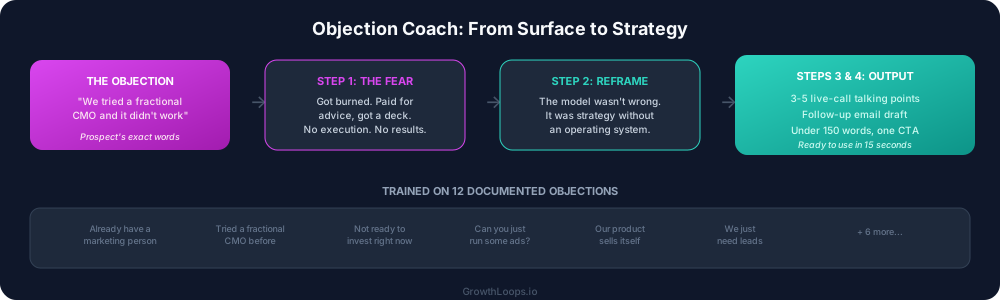
How the objection coach works
You give the agent one input: the objection, in the prospect's exact words. Not your interpretation of it. Their actual language.
Step 1: Surface the real fear. Every objection is a surface-level expression of a deeper concern. "We are not ready to invest in marketing" usually means "I have been burned before and I do not trust that this will produce results." "We already have a marketing person" often means "I am afraid of admitting that person is not working out." The agent identifies the fear underneath the words.
Step 2: The strategic reframe. This is not about having a clever comeback. It is about shifting the conversation from the objection to the real problem. The agent provides a reframe that acknowledges the fear, validates it, and redirects to the value of solving the actual problem. No defensiveness. No hard sell. Just a shift in perspective.
Step 3: Live-call talking points. Three to five specific things you can say on the call, in order. Not scripts. Talking points that give you a structure while leaving room to be natural. Each one builds on the last so the conversation flows toward a next step.
Step 4: Follow-up email. A short email you can send after the call that reinforces the reframe. One CTA. Under 150 words. Ready to copy and paste.
The objection library it draws from
The agent is not guessing at common objections. It references a master list of 12 objections that I have catalogued from years of selling marketing services to B2B SaaS companies:
- We already have a marketing person.
- We tried a fractional CMO before and it did not work.
- We are not ready to invest in marketing right now.
- Can you just run some ads for us?
- Our product sells itself.
- We just need leads.
- Marketing has not worked for us before.
- We cannot afford senior marketing leadership.
- We need someone full-time.
- We want to keep marketing in-house.
- Our sales team drives all our revenue.
- We are too early for a CMO.
Each of these objections has a documented fear pattern, a proven reframe, and specific proof points that address the concern. The agent draws from all of that context when it generates its response.
Why this matters beyond sales calls
The objection coach is not just for live conversations. It is a strategic tool that informs your entire marketing operation.
Content strategy. If you know the top objections your buyers have, you know what content to create. Every objection is a blog post, a LinkedIn post, a case study, a webinar topic. The objection coach surfaces the angles that will resonate most.
Sales enablement. If you have a sales team, the objection coach gives them a consistent framework instead of hoping everyone figures it out on their own. New reps get up to speed faster. Experienced reps get sharper reframes.
Messaging refinement. If the same objection keeps coming up, it means your positioning has a gap. The objection coach helps you identify those gaps and address them proactively in your marketing so fewer prospects raise the objection in the first place.
A real example
Here is what happens when you feed the agent: "We tried a fractional CMO before and it did not work."
The fear underneath: They got burned. Someone came in, made a bunch of recommendations, produced a strategy deck, and nothing changed. The prospect is afraid of paying for advice and getting no execution, no accountability, and no results.
The reframe: The problem was not fractional CMO as a model. The problem was fractional CMO without an operating system. A strategy without execution infrastructure is just a deck. What I build is the system: the agents, the workflows, the measurement framework, and the team structure to actually run it.
Talking point: "I hear that a lot. Can I ask what happened? In most cases, the issue is not the strategy. It is that there was no system to execute it. What I do differently is build the operating system alongside the strategy. The agents, the workflows, the metrics. So when I leave, the system keeps running."
That is not a generic objection handling response. That is a response built on pattern recognition from real sales conversations with real B2B SaaS buyers.
Where it fits in the system
The objection coach is one of 20 AI agents in the GrowthLoops marketing operating system. It works best when paired with the authority agent (which pulls proof points and case studies for each objection) and the email agent (which can build full outbound sequences that preemptively address the most common objections).
The agents do not work in isolation. They share context. That is what makes the system more than the sum of its parts.