The AI Quality Control Agent That Catches What Humans Miss
I have a list of words I never want to appear in my marketing. Synergy. Leverage as a verb. Holistic. Thought leader. Innovative. Disruptive. Seamless. Robust. These words mean nothing. They are filler that signals "I did not have anything specific to say so I used a buzzword instead."
I also have rules about how my content should sound. Statement openers only on LinkedIn. Never start a blog post with a question. Lead with pipeline metrics, not activity metrics. Soft CTAs, never hard sell. Specificity over platitudes. Every piece should map to a messaging pillar and target a specific persona.
When I was writing everything myself, I could enforce these rules through discipline. When I started building AI agents that generate content at scale, discipline was not enough. I needed a system.
So I built a quality control agent that reviews every piece of marketing output against the full brand rule set before it goes anywhere.
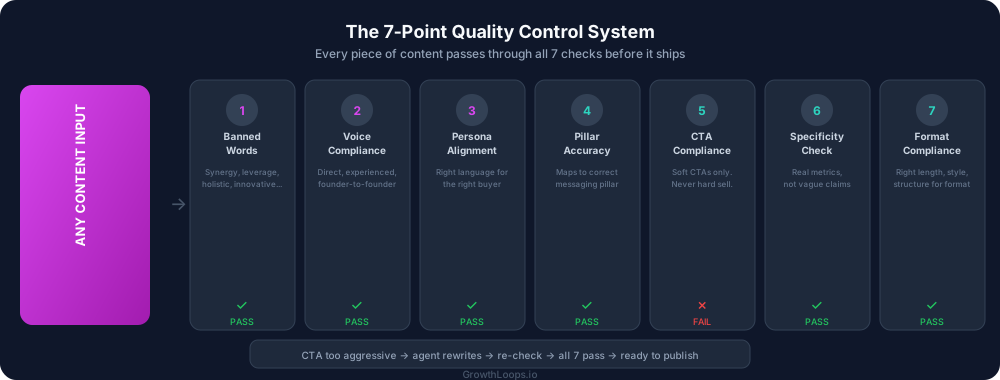
What the QC agent checks
The agent runs seven checks on every piece of content. Each check produces a pass or fail with specific violations flagged and revision suggestions provided.
Check 1: Banned words. The agent scans for every word and phrase on the banned list. This is not just the obvious ones. It catches variations and near-misses too. "Leveraging" gets flagged just like "leverage." "Thought leadership" gets flagged just like "thought leader." If a banned word appears, the agent suggests a specific replacement.
Check 2: Voice compliance. Is the tone direct and experienced? Does it sound like a founder-to-founder conversation? Does it read like someone who has been in the room, or does it read like a marketing blog? The agent evaluates the overall voice against the brand guidelines and flags sections that drift.
Check 3: Persona alignment. Every piece of content should be written for a specific buyer persona. The agent checks whether the language, pain points, and proof points match the target persona. A post aimed at technical founders should not use the same language as one aimed at burned buyers. If the persona targeting is off, the agent explains why and suggests adjustments.
Check 4: Pillar accuracy. Content should map to one of the five messaging pillars. The agent verifies that the content actually supports the intended pillar and does not accidentally drift into a different narrative. This is the check that keeps your content strategy coherent over time instead of slowly wandering off message.
Check 5: CTA compliance. The agent checks that every CTA is soft, not hard sell. No "book a demo now." No "sign up today." The CTA should feel like a natural next step, not a sales pitch. If the CTA is too aggressive, the agent rewrites it.
Check 6: Specificity check. This is the check that catches lazy writing. The agent looks for vague claims and generic statements that could apply to any company. "We help companies grow" fails. "We scaled pipeline 140% in 18 months at LeanLaw" passes. If a claim is vague, the agent flags it and asks for a specific metric or example.
Check 7: Format compliance. Different formats have different rules. LinkedIn posts should be 150 to 250 words with statement openers. Blog posts should be 800 to 1,200 words with H2 structure. Emails should be under 150 words with one CTA. The agent checks that the content follows the rules for its intended format.
Why this matters at scale
When you are producing one or two pieces of content per week, quality control is manageable. You read it. You catch the issues. You fix them.
When you are running a content repurposing engine that produces 24 pieces from a single blog post, manual QC is impossible. You cannot read 24 pieces of content and check each one against seven criteria. You will miss things. Your brand will drift. Banned words will slip through. Persona targeting will get sloppy.
The QC agent makes scale possible without sacrificing consistency. Every piece of content, whether it is written by you, by a team member, or by another AI agent, goes through the same seven checks. The standard does not slip because the standard is automated.
How it works in practice
The QC agent reads the brand bible (the CLAUDE.md file that contains all the voice rules, personas, pillars, and banned words) and then evaluates whatever content you give it.
You can run it two ways:
Manual review. Paste any piece of content and the agent produces a full QC report. Seven checks, each with a pass or fail, specific violations, and revision suggestions. This is useful for reviewing content from freelancers, agencies, or team members who are still learning the brand voice.
Automated pipeline. The QC agent runs automatically on the output of other agents in the system. When the LinkedIn agent writes a post, the QC agent reviews it before it reaches you. When the email agent drafts a sequence, the QC agent checks every email. You only see content that has already passed all seven checks.
The automated pipeline is the real unlock. It means your AI agents are not just generating content. They are generating quality-controlled content. The QC agent is the editor that never gets tired, never misses a banned word, and never lets a vague claim slide.
The deeper value
The QC agent does something more important than catching errors. It enforces institutional knowledge.
Every brand rule in the system exists because of a lesson learned. The banned words list exists because those words dilute messaging. The persona alignment rules exist because generic content does not convert. The specificity check exists because vague claims do not build trust.
When those rules live in a document that people are supposed to read and follow, they get ignored. When those rules live in an automated QC system that checks every piece of content, they get enforced. Every time. Without exception.
That is the difference between having brand guidelines and actually living them. The QC agent turns guidelines into a system.