The CLAUDE.md File: Why Context Beats Prompts Every Time
Every marketer I talk to who has tried AI and been disappointed has the same story. They opened ChatGPT. They typed a detailed prompt. They got a response that was technically fine but strategically worthless. They tried again with a better prompt. Slightly better result. Still generic. Still sounded like AI. Still did not understand their business.
The problem was never the prompt. The problem was the context.
A prompt is a one-time instruction. Context is persistent knowledge that shapes every output. The difference is the difference between telling someone what to do once and giving them the background to make good decisions on their own.
In Claude Code, context lives in a file called CLAUDE.md. It is the single most important file in your marketing operating system. Here is why.
What CLAUDE.md does
CLAUDE.md is a markdown file that sits in the root of your project directory. Every time Claude Code runs any command, any skill, any workflow, it reads this file first.
That means every agent in your system starts with the same foundation of knowledge. Your brand. Your buyers. Your voice. Your positioning. Your rules.
Without this file, each agent is a blank slate. You have to re-explain your business every time you run anything. With this file, each agent already knows who you are, who you serve, and how you communicate.
The before and after
Without CLAUDE.md: "Write a LinkedIn post about why B2B SaaS companies should invest in marketing leadership."
Output: "In today's competitive B2B SaaS landscape, investing in marketing leadership is more important than ever. Here are five reasons why your company should consider bringing on a senior marketing leader..."
Generic. Could be about any company. Uses exactly the language a banned words list would catch. Starts with a filler intro. No persona targeting. No proof points.
With CLAUDE.md: Same request.
Output: A post written in your voice, targeting the specific persona you defined, opening with a statement (not a question), referencing a real metric from your career, mapping to one of your messaging pillars, ending with a soft CTA. No banned words. No filler. Sounds like you wrote it.
Same AI. Same request. Completely different output. The only variable is the context file.
What goes in the file
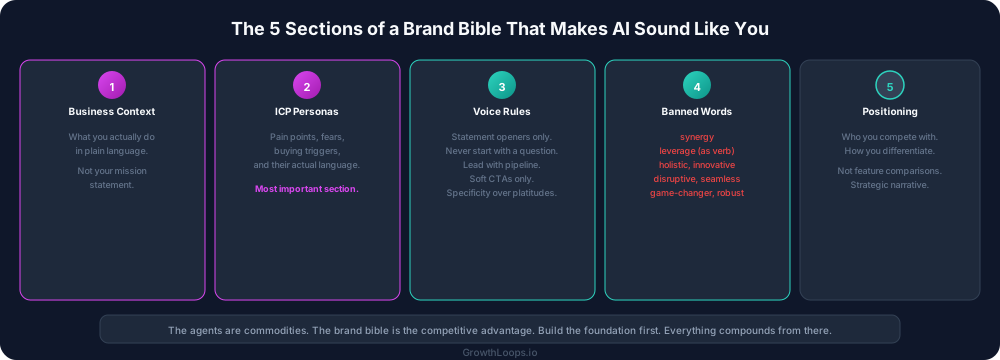
I covered the full brand bible structure in a previous post, but here is the quick version:
Business context. What you do, who you serve, in plain language.
Personas. Two to four buyers with their pain points, fears, triggers, and language. Not demographics. Behavioral profiles.
Voice rules. How you sound. Statement openers only. No questions to open. Lead with pipeline. Specificity over platitudes. Soft CTAs.
Banned words. Everything that signals AI-written or lazy marketing. The longer the list, the better the output.
Competitive positioning. How you differentiate from the alternatives.
Career data and proof points. Real metrics and accomplishments that agents can reference when they need specificity.
Why context compounds and prompts do not
Here is the insight that changed how I think about AI tools.
A great prompt produces great output once. Tomorrow, the prompt is gone. The AI has no memory of it. You start from zero.
A great CLAUDE.md file produces great output every time, from every agent, on every execution. And it gets better. Every time you refine a persona based on a real sales conversation, every agent gets smarter. Every time you add a banned word you spotted in agent output, every agent avoids it going forward.
The brand bible compounds. Six months of refinements produce an AI system that understands your business better than most employees. Not because the AI is smart. Because the context is deep.
A company that started building their CLAUDE.md six months ago has a system that produces dramatically better output than one started yesterday. That gap cannot be closed with better prompts. It can only be closed with time and iteration on the context.
The most common mistakes
Mistake 1: Writing it like a brand guidelines document. Nobody reads those. Not humans, and not AI in the way you want. Write it like you are briefing a sharp new hire on their first day. Direct. Specific. Practical.
Mistake 2: Being vague about personas. "Marketing leaders at mid-size companies" is useless. "Jordan: VP Marketing at $15M ARR SaaS company who hired two agencies in the past year, both produced decks instead of pipeline, now deeply skeptical of outside marketing help." That is useful.
Mistake 3: Skipping the banned words. This is the section people think is optional. It is the most impactful section in the file. Every banned word you add eliminates a category of generic output.
Mistake 4: Writing it once and never updating. The CLAUDE.md file should change weekly. Not big rewrites. Small refinements. A persona insight from a sales call. A voice rule you noticed was missing. A proof point from a recent campaign. The file is alive.
The test
Open Claude Code with your CLAUDE.md file in place. Ask it to write a LinkedIn post. Just give it a topic. No other instructions.
Read the output. Does it sound like your brand? Does it target a specific buyer? Does it include specific proof points? Are the banned words absent?
If yes, your context is working. If no, the file needs work. The good news is that every fix makes every future output better. That is the compounding advantage of context over prompts.