The Content Repurposing Engine: One Post Becomes 100 With an AI Agent
Every marketer knows they should be repurposing content. Take a blog post, turn it into LinkedIn posts, email nurtures, TikTok scripts, ad copy. The playbook is not new. The problem is that nobody actually does it well.
Here is what usually happens. Someone writes a blog post. Then a junior marketer copies the intro paragraph into a LinkedIn post and calls it repurposed. Maybe they pull a quote for a social graphic. The blog post and the LinkedIn post say the same thing in the same way to the same audience. That is not repurposing. That is reformatting.
Real repurposing means taking one core insight and reframing it through different lenses for different audiences in different formats. That requires strategic thinking. It requires understanding your personas, their objections, and what angle will land with each of them. Most marketing teams do not have the bandwidth to do that for every piece of content.
So I built an AI agent that does.
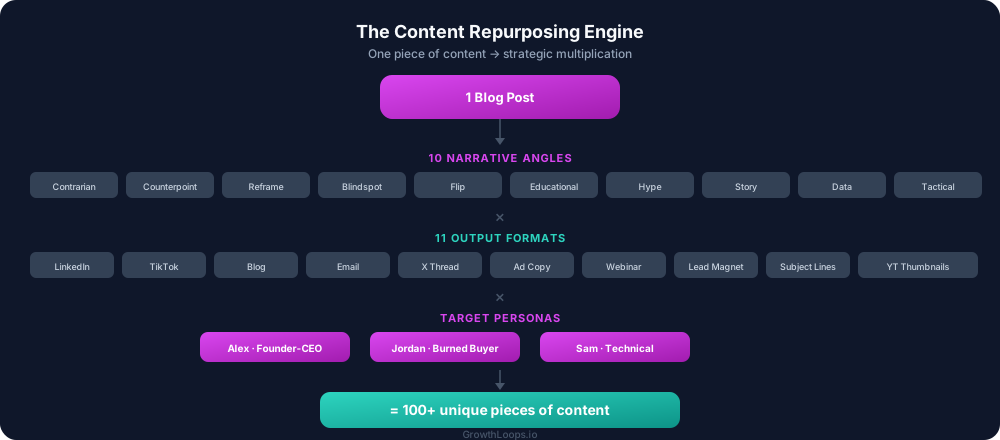
What the repurposing engine actually does
The content repurposing engine is not a summarizer. It does not take your blog post and make it shorter for LinkedIn. It takes the core insight from any piece of content and multiplies it across 10 different narrative angles and 11 output formats, tailored to each of your buyer personas.
Here is how the process works.
Step 1: Extract the core insight. You paste in any piece of content. A blog post, a podcast transcript, a webinar recording summary, a sales call note. The agent strips away the format and identifies the one thing your content is really saying. It also maps the proof points, the current angle, the target persona, and the original format.
Step 2: The 360-degree view. This is where it gets interesting. The agent generates 10 different angles on your core insight:
- Contrarian. Challenge the accepted wisdom around your topic.
- Counterpoint. Run the narrative nobody else is running.
- Reframe. Flip the lens entirely. If your post is about what to do, the reframe is about what to stop doing.
- Blindspot. Surface what everyone in your market is missing.
- Flip. The unpopular opinion, stated directly.
- Educational. Teach the framework behind the insight.
- Hype. The momentum angle. This is the moment. Here is why.
- Story. Personal narrative or case study that illustrates the point.
- Data. Lead with the numbers that prove the insight.
- Tactical. The step-by-step playbook your reader can execute tomorrow.
You pick which angles to develop. Maybe the contrarian angle does not fit this topic. Maybe the data angle is perfect. You choose.
Step 3: Pick your formats. The agent supports 11 output formats:
- LinkedIn post (150 to 300 words, statement openers, no hashtag spam)
- 60-second TikTok script (hook, body beats, CTA, visual direction)
- Blog post (800 to 1,200 words with H2 structure)
- Email (cold, nurture, or follow-up)
- Twitter/X thread (5 to 8 tweets)
- Ad copy (LinkedIn, Meta, and Google with three variations each)
- Webinar talking points
- Lead magnet intro
- Email subject lines (10 options)
- YouTube thumbnail text
Step 4: Persona targeting. Every piece gets tailored to your specific buyer personas. A LinkedIn post for a technical founder reads completely differently than one for a burned buyer who just fired their last agency. Same core insight, different framing, different proof points, different language.
The output is a full content matrix. Every combination of angle, format, and persona that you selected, fully written and ready to use.
Why this is not just "AI content generation"
The difference between this agent and asking ChatGPT to "write me a LinkedIn post about my blog" is the strategic layer.
The repurposing engine knows your brand voice rules. It knows your banned words. It knows the difference between your personas and what motivates each of them. It knows which messaging pillar each piece of content should map to. And it checks all of that before it outputs anything.
Every piece of content comes with adaptation notes that show which angle was applied, which persona it targets, what formatting adjustments were made, and whether it passed the voice and banned word checks.
This is not content volume for the sake of volume. It is strategic content multiplication where every piece has a reason to exist.
The math that matters
Let me put real numbers on this.
One blog post through the repurposing engine with three angles, four formats, and two personas produces 24 unique pieces of content. Each one is strategically differentiated. Each one is persona-targeted. Each one is voice-checked.
If you publish one blog post per week and run it through the engine, you have 96 pieces of content per month. That is more than most B2B SaaS marketing teams produce in a quarter, and it is all connected to the same strategic foundation.
A content team of three people producing that volume would cost you $250,000 to $350,000 per year in salary and benefits. The repurposing engine runs for the cost of the API calls.
Try it yourself
This agent is open source. You can clone the repo at github.com/Laura-Beaulieu/growthloops-claude-skills, add your brand details to the CLAUDE.md file, and run /repurpose in Claude Code.
Paste in any piece of content and watch it multiply.
Where it fits in the system
The repurposing engine is one of 20 AI agents I have built as part of the GrowthLoops marketing operating system. It works best when paired with the other agents in the system.
Run a competitive scan with the competitive ads agent. Find a messaging gap. Write a blog post about it. Run it through the repurposing engine. Now you have a full content response to a competitive opportunity, from insight to 24 pieces of content, in a single afternoon.
That is what go-to-market engineering looks like. Not more people. Not more tools. Better systems that compound.