The Exact Workflow: How a Blog Post Goes From Idea to Published With AI
I publish multiple blog posts per week. Each one is AEO-optimized with structured data for AI answer engines. Each one targets a specific buyer persona. Each one passes a seven-point quality control check. And each one gets repurposed into LinkedIn posts, email content, and social media assets.
I do not have a content team. I have a marketing operating system built with AI agents and Claude Code.
People ask me how the workflow actually works. Not the theory. The literal steps from idea to published. So here it is, step by step.
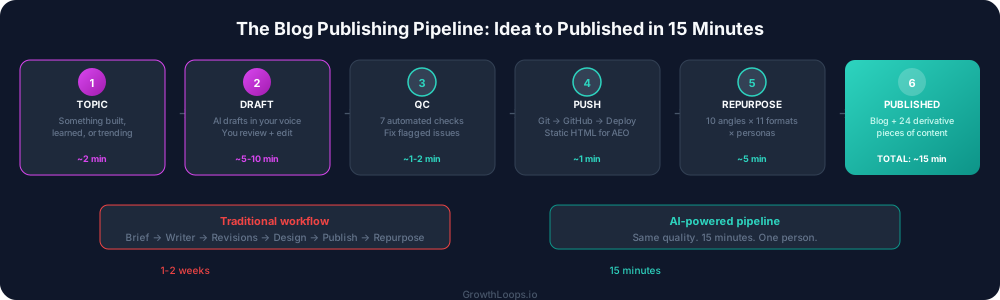
Step 1: Pick the topic
This starts with one of three inputs.
Something I built. I build AI agents constantly. Every new agent is a blog post. The competitive ads agent became "How I Built an AI Competitive Ads Agent That Scans Meta, LinkedIn, and Google in Minutes." The repurposing engine became "The Content Repurposing Engine: One Post Becomes 100 With an AI Agent." The work generates the content.
Something I learned. Client engagements surface insights about what B2B SaaS teams struggle with. Competitive scans reveal market patterns. Conversations with founders expose common fears and objections. All of that is content material.
Something the market is talking about. The AI news agent monitors relevant developments. The LinkedIn intelligence agent tracks what thought leaders are posting about. The Lenny's podcast agent surfaces frameworks and data points. These inputs keep me current and give me angles to respond to.
The content strategist agent takes whatever input I give it and maps it to a messaging pillar, a persona, a funnel stage, and recommended angles. This ensures every post has a strategic reason to exist, not just a topic.
Step 2: Draft the post
I tell Claude Code what I want to write about and who it is for. The blog agent drafts a full post: 800 to 1,200 words, H2 structure, statement opener, persona-specific language, relevant proof points from my career, and a soft CTA.
The agent reads my brand bible before it writes anything. It knows my voice rules, my banned words, my personas, and my messaging pillars. It knows to lead with pipeline, not activities. It knows to use specifics, not platitudes. It knows never to start with a question or use an em dash.
The draft takes about 30 seconds to generate. I read it, make edits where I want to add a personal detail or sharpen a point, and move on. Total time: five to ten minutes.
Step 3: Quality control
The QC agent reviews the post against seven criteria: banned words, voice compliance, persona alignment, pillar accuracy, CTA compliance, specificity check, and format compliance.
If something fails, the agent flags the specific violation and suggests a fix. I make the correction and run QC again. Most posts pass on the first or second round because the blog agent already reads the brand rules. The QC agent is the safety net that catches what slips through.
Step 4: Add to the blog index
Every blog post lives as a markdown file in the site repo. I add the post to a metadata index that includes the title, slug, description, date, tags, and read time. This index is what the blog page reads to display the list of posts.
Step 5: Push to GitHub
One command. The post gets committed and pushed to the GitHub repo. The site builds automatically.
Here is the part that makes this AEO-ready: a build script runs after the site compiles that generates a full static HTML page for every blog post. Not a JavaScript-rendered page that AI crawlers cannot read. A complete HTML file with the article content, meta tags, Open Graph data, and BlogPosting structured data baked directly into the markup.
When Perplexity, ChatGPT, or Google's AI Overview crawls the page, they get the full article content without needing to execute JavaScript. That is the difference between being visible to AI answer engines and being invisible.
Step 6: Repurpose
The content repurposing engine takes the blog post and generates derivative content across multiple angles and formats. LinkedIn posts, email sequences, TikTok scripts, ad copy. Each one tailored to a specific persona and checked against the brand voice rules.
One blog post becomes the seed for an entire week of content across every channel.
The full timeline
Here is how long each step actually takes:
- Topic selection: 2 minutes (often instant because the work generates the topics)
- Drafting: 5 to 10 minutes (30 seconds for the AI draft, the rest for my review and edits)
- Quality control: 1 to 2 minutes
- Index and push: 1 minute
- Repurposing: 5 minutes (select angles and formats, review output)
Total: 15 to 20 minutes from idea to published blog post with AEO optimization and a week of derivative content.
Compare that to a traditional content workflow. Briefing a writer: 30 minutes. Writer produces a draft: 2 to 3 days. Review and edits: 1 hour. Designer creates graphics: 2 to 3 days. Publish: 30 minutes. Repurpose manually: 2 to 4 hours. Total: one to two weeks.
What makes this sustainable
The workflow is sustainable because it is a system, not a heroic effort. I am not grinding through content production. I am running a pipeline that is set up to produce consistent, quality-checked, strategically aligned content at a pace that would be impossible manually.
The system also gets better over time. Every post I write refines the brand voice. Every QC check catches a new edge case that gets added to the rules. Every repurposing run teaches me which angles work best for which personas.
The first blog post took longer because the system was new. Post number 20 takes 15 minutes because the system is dialed in.
That is the compounding advantage. Not just the content. The system that produces it.
Why I am telling you this
Because every B2B SaaS marketing team can build this workflow. Not the exact same system. Their own version, tailored to their brand, their personas, and their channels.
The tools are available. Claude Code is accessible to anyone. The agent-building framework is something any marketer can learn. The AEO optimization approach is straightforward once you understand what AI answer engines need.
The teams that build this pipeline first will dominate their category's search and AI answer visibility. The teams that wait will wonder why their content is not showing up in AI-generated responses.
The workflow is here. The question is whether you build it this month or next year.