The Future of Go-to-Market Is Not More Hires. It Is Go-to-Market Engineers.
Every B2B SaaS company I talk to has the same problem. They need more marketing output, but they cannot afford more headcount. So they buy another tool. Then another. Then they hire an agency. Then they fire the agency. The cycle repeats.
I lived that cycle for a decade running marketing at companies like Holistaplan, LeanLaw, and ApexEdge. I scaled teams. I managed agencies. I spent the budgets. And I can tell you exactly where it breaks down.
The model is broken. Not because the people are bad. Because the model was built for a world where humans were the only option for executing marketing work.
That world ended about 18 months ago.
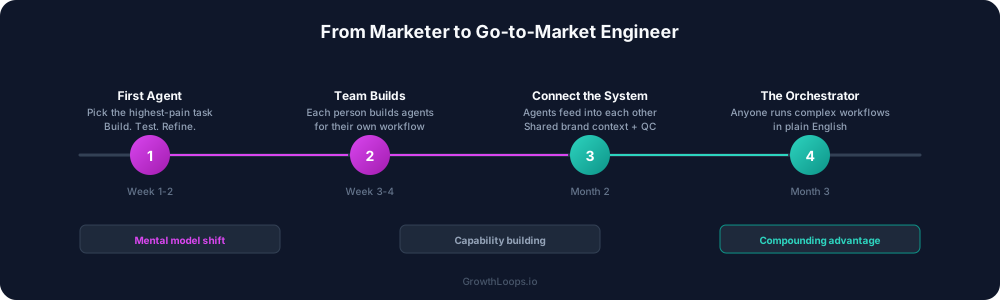
What is a go-to-market engineer?
A go-to-market engineer is a marketer who builds their own tools. Not in a theoretical "learn to prompt ChatGPT" way. In a real, tangible, "I built an AI agent that runs our competitive intelligence every week" way.
This is not about replacing marketers with engineers. It is about giving marketers engineering capabilities so they can build the systems that multiply their output by 10x or more.
Think about what a senior marketer actually does day to day. They research competitors. They write content. They analyze performance data. They build strategy decks. They handle objections on sales calls. They repurpose one piece of content across six channels.
Every single one of those tasks can now be handled by an AI agent that a marketer builds and trains themselves, using tools like Claude Code.
The proof is in what I built
I am not talking about theory. Over the past few months, I have built 20 AI agents that now run the core functions of a marketing department:
A competitive ads intelligence agent that scans Meta, LinkedIn, and Google ad libraries and delivers a full competitive analysis in minutes. That used to take a junior analyst a full week.
A content repurposing engine that takes one blog post and turns it into 100+ pieces of content across 10 different angles and 11 formats, tailored to specific buyer personas. That used to require a content team of three.
An 18-exercise marketing strategy audit that produces the same deliverable I would charge $15,000 to build as a fractional CMO. It runs in an afternoon.
A TikTok analytics agent that scrapes performance data, categorizes every video by topic and hook style, and tells me exactly what content to make next. That used to require a dedicated social media analyst.
A quality control agent that reviews every piece of content against our brand voice rules, banned words, persona alignment, and messaging pillars before it goes out the door.
And here is the one that really puts the shift in perspective. I used to pay an SEO agency $8,000 a month. They were good. They crushed it. But last week, I built an entire AEO-optimized blog pipeline with Claude Code in a single afternoon. The blog drafts here, gets pushed to GitHub, and publishes to my website with full structured data for AI answer engines. Total cost: about $100 a month.
That is not a cost savings story. That is a capability story. I can now do things that were not possible before, at a speed that was not possible before, with a level of strategic consistency that a rotating cast of agencies could never maintain.
Why this matters for your marketing team
The marketing teams that win over the next two years will not be the ones with the biggest headcount or the most tools in their stack. They will be the ones where every team member can build, train, and deploy AI agents that handle the repetitive, research-heavy, and execution-intensive parts of their job.
Here is what that looks like in practice:
Your demand gen person does not just run campaigns. They build an agent that monitors competitor ad creative in real time and surfaces messaging gaps your team can exploit.
Your content marketer does not just write blog posts. They build an agent that takes every webinar transcript and turns it into a month of LinkedIn content, email nurtures, and short-form video scripts.
Your marketing ops person does not just manage the tech stack. They build agents that pull data from six platforms, run the analysis, and deliver a weekly performance brief that would have taken two days to compile manually.
This is not futuristic. I have already built every one of these agents. They work. They are running today.
How to start building go-to-market engineers inside your org
You do not need to hire developers. You do not need a $500K AI transformation budget. You need three things:
1. Pick one workflow that eats your team's time. Competitive research, content repurposing, performance reporting. Whatever it is, pick the one that is most repetitive and most time-consuming.
2. Build the agent. Tools like Claude Code let marketers build AI agents using natural language. No Python required. You describe what you want the agent to do, give it your brand context and personas, and it executes.
3. Train your team to think in systems, not tasks. The shift is not "use AI to write faster." The shift is "build a system that handles this category of work so you can focus on strategy and judgment."
The companies that figure this out first will have a compounding advantage. Every agent you build makes the next one easier. Every workflow you automate frees your team to build the next system. It compounds.
The bottom line
The future of go-to-market is not more hires, more agencies, or more tools. It is go-to-market engineers: marketers who build AI agents as members of their team, with defined roles, system prompts, and feedback loops.
I am building these systems every day at GrowthLoops. Some of them I have open-sourced so any B2B SaaS marketing team can start using them today. The rest I build custom for clients who want the full operating system.
If you are a founder or marketing leader at a B2B SaaS company and you want to see what this looks like for your team, that is a conversation worth having.