The Marketing Operating System: What Comes After the Tool Stack
Every B2B SaaS marketing team I walk into has too many tools and no system connecting them.
HubSpot for email. Salesforce for CRM. Google Analytics for web. LinkedIn for organic. Meta for paid. Canva for design. Notion for planning. Slack for communication. Gong for call recording. Six or seven dashboards that nobody looks at on the same day.
Each tool does its job fine. The problem is that the space between the tools is where marketing actually happens. The decision about which competitive insight should become a blog post. The judgment call about which persona that blog post should target. The workflow that turns that blog post into a LinkedIn post, an email nurture, a TikTok script, and three ad variations. The QC check that makes sure everything is on brand before it goes live.
That space between the tools is filled by people. People who are expensive, slow, inconsistent, and who take their institutional knowledge with them when they leave.
A marketing operating system fills that space with AI agents.
What a marketing operating system actually is
It is not another tool. It is not a platform. It is not a dashboard.
A marketing operating system is the connective tissue between your strategy and your output. It is the set of AI agents that execute the workflows your team runs every day, informed by your brand context, your personas, and your strategic priorities.
Here is the difference:
A tool stack is a collection of software that does specific tasks. Email marketing. CRM. Analytics.
A marketing operating system is a collection of AI agents that do specific jobs, informed by a shared context, coordinated by an orchestrator, and quality-checked against your brand rules.
The tool stack stores data and provides interfaces. The operating system thinks, executes, and maintains quality.
The architecture
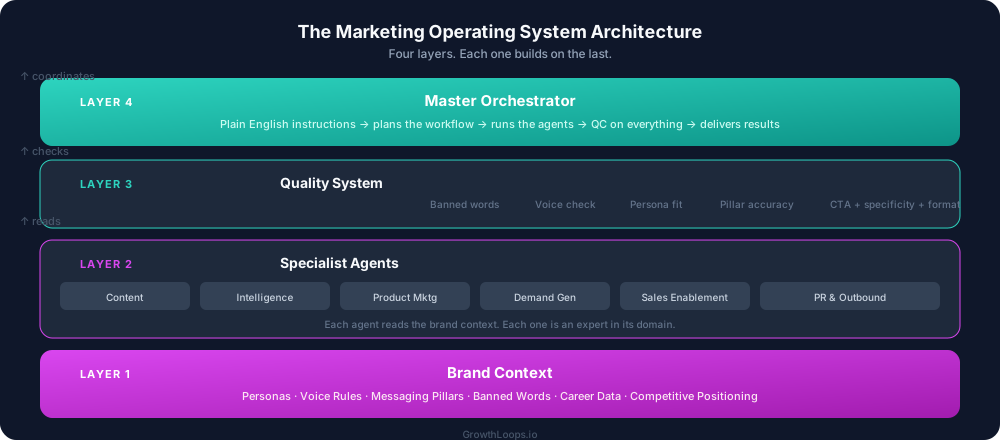
Every marketing operating system has four layers.
Layer 1: The brand context. This is the foundation. Your brand bible, your personas, your voice rules, your messaging pillars, your competitive positioning, your metrics, your banned words. Every agent in the system reads this context before it executes anything. This is what gives the system its strategic intelligence.
Without this layer, you have AI tools that produce generic output. With this layer, you have AI agents that produce output that sounds like your brand, targets your buyers, and advances your strategic narrative.
Layer 2: The specialist agents. Each agent handles a specific marketing function. Content writing. Competitive intelligence. Email sequences. Objection handling. Strategy audits. Analytics. Visual briefs. Each one is an expert in its domain, trained on your brand context, and designed to produce output you can use immediately.
Layer 3: The quality system. Every piece of output runs through automated quality control before it reaches a human. Banned word checks. Voice compliance. Persona alignment. Pillar accuracy. CTA compliance. Specificity checks. Format checks. This layer is what makes scale possible without sacrificing consistency.
Layer 4: The orchestrator. One agent that coordinates all the others. It takes plain English instructions, plans the workflow, runs the agents in sequence, passes output between them, runs QC on everything, and delivers a complete package. This is the layer that makes the system accessible to anyone on the team, not just the person who built it.
Why the tool stack model is breaking
The tool stack model worked when the bottleneck was functionality. We needed a tool to send email. We needed a tool to track leads. We needed a tool to measure web traffic.
Those problems are solved. Every B2B SaaS marketing team has the tools. The bottleneck is no longer functionality. The bottleneck is execution with strategic coherence.
Your team has the tools to publish on LinkedIn. They do not have a system that ensures every LinkedIn post maps to a messaging pillar, targets a specific persona, and is checked against the brand voice rules before it goes live. That is the gap.
Your team has the tools to run competitive research. They do not have a system that turns competitive insights into content responses within 24 hours. That is the gap.
Your team has the tools to create content. They do not have a system that multiplies one piece of content across ten angles, eleven formats, and multiple personas without anyone manually reformatting. That is the gap.
The gaps are not in the tools. The gaps are in the space between the tools. And that is exactly what a marketing operating system fills.
How to build one
You do not build a marketing operating system all at once. You build it one agent at a time, starting with the workflow that causes the most pain.
Step 1: Build the brand context. Write the brand bible. Define the personas. Document the voice rules. List the banned words. Map the messaging pillars. This is the foundation everything else reads. It takes a few days to do well. It saves months down the line.
Step 2: Build your first agent. Pick the highest-pain workflow. Build the agent. Test it. Refine it. Use it daily for two weeks.
Step 3: Add agents incrementally. Each new agent should connect to the existing system. The competitive intelligence agent's output should inform the content agent. The content agent's output should run through the QC agent. Build connections, not standalone tools.
Step 4: Add the orchestrator. Once you have five or more agents, the orchestrator becomes essential. It is what turns a collection of agents into a system that anyone can use.
Step 5: Iterate on the brand context. Every engagement, every campaign, every competitive scan teaches you something new about your market. Feed those learnings back into the brand bible. The system gets smarter over time because the foundation gets more refined.
The compounding advantage
A marketing operating system compounds in a way that a tool stack never can.
Every agent you add makes the system more capable. Every refinement to the brand context makes every agent more accurate. Every workflow you automate frees your team to build the next workflow.
A tool stack has a linear return. Add a tool, get a capability. A marketing operating system has an exponential return. Add an agent, and every other agent in the system benefits from the new capability.
The companies that build their operating system first will have a structural advantage that is very difficult to compete with. Not because the technology is proprietary. Because the accumulated brand context, the refined workflows, and the compounding intelligence cannot be replicated overnight.
The tool stack got you here. The operating system gets you where you are going.