The Master Orchestrator: One AI Agent That Runs All the Others
I built 20 AI marketing agents. Each one handles a specific job. Competitive intelligence. Content writing. Email sequences. Objection handling. Strategy audits. Quality control. Visual briefs. Analytics.
Individually, each agent is useful. Together, they are a marketing department.
But there was a problem. Running them together required knowing which agent to call, in what order, with what inputs. If I wanted to go from "I just heard about a competitor's new campaign" to "we have a full content response published across four channels," I had to manually orchestrate five or six agents in sequence. I had to remember the workflow. I had to pass outputs from one agent as inputs to the next.
That is fine when it is just me. It does not scale to a team. And it definitely does not scale to a client who wants to use the system without memorizing 20 commands.
So I built the master orchestrator. One agent that understands plain English, plans which agents to run and in what order, executes each one with the right inputs, runs quality control on all outputs, and delivers a summary of what was produced and what to do next.
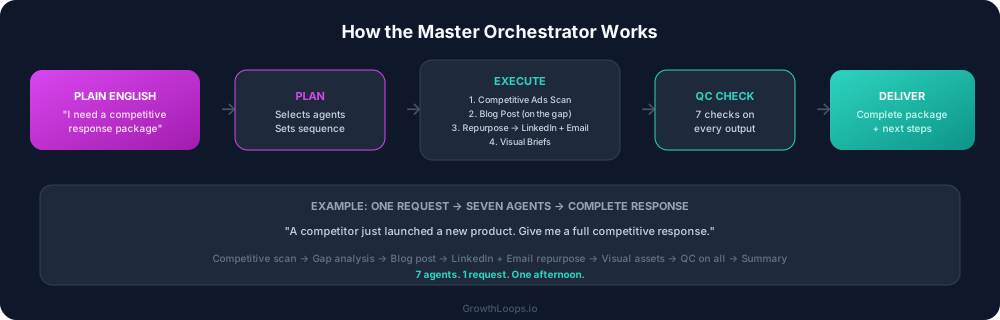
How the orchestrator works
You tell it what you want in plain English. That is it.
"I need a LinkedIn post about why founder-led growth stops working, targeted at the Alex persona."
The orchestrator reads that request and plans the execution:
- Run the content strategist to map the topic to the right pillar, persona, and angle.
- Run the LinkedIn agent with the strategy output to generate the post.
- Run the QC agent to check the post against all brand rules.
- Deliver the final, quality-checked post.
Four agents. One request. You never have to think about agent sequencing.
Here is a more complex example:
"A competitor just launched a new product. I need a full competitive response: analyze their ads, find the messaging gaps, write a blog post about the gap, repurpose it for LinkedIn and email, and create visual assets for the LinkedIn posts."
The orchestrator plans:
- Run the competitive ads agent to scan the competitor's current ad creative.
- Analyze the output to identify messaging gaps.
- Run the blog agent to write a post addressing the strongest gap.
- Run the content repurposing engine to generate LinkedIn posts and email sequences from the blog.
- Run the visual marketing agent to create creative briefs for the LinkedIn assets.
- Run the QC agent on every piece of output.
- Deliver everything with a summary and next steps.
Seven agents. One request. The orchestrator handles the sequencing, the input passing, and the quality control.
Why orchestration matters
Without an orchestrator, a multi-agent system is just a collection of tools. You still need a person who understands the system well enough to run it. That person becomes a bottleneck.
With an orchestrator, anyone on your team can use the full power of 20 agents by describing what they need in plain language. The marketing coordinator who just started last month can request a competitive response package and get the same quality output as the CMO who built the system.
This is the part that makes AI agents a real team capability instead of one person's toolkit.
It reduces training time. New team members do not need to learn 20 commands. They need to learn how to describe what they need.
It ensures consistency. The orchestrator always runs QC on everything. It always follows the same workflow patterns. The output quality does not depend on whether the person running it remembered to check the brand guidelines.
It enables complex workflows. Some of the most valuable marketing workflows require five or six agents running in sequence. Without an orchestrator, those workflows are too complex for most people to run. With the orchestrator, they are one sentence.
What the orchestrator does not do
The orchestrator is not an autopilot. It does not make strategic decisions. It does not decide whether you should respond to a competitor's campaign or ignore it. It does not choose which persona to target or which angle to take.
Those decisions are yours. The orchestrator executes them.
This is an important distinction because it is where a lot of AI automation goes wrong. Companies try to remove human judgment from the loop entirely and end up with output that is technically competent but strategically incoherent. The orchestrator keeps human judgment at the top of the chain while automating everything below it.
You decide what needs to happen. The orchestrator figures out how to make it happen using the agents available to it.
What this means for marketing teams
The master orchestrator is the piece that turns a collection of AI agents into an operating system. Without it, you have 20 useful tools. With it, you have a marketing department that responds to plain English instructions.
For a founder who is still running marketing themselves, the orchestrator means they can describe what they need and get CMO-quality output without knowing anything about marketing workflows. The system knows the workflows. They just need to know what they want.
For a marketing leader with a team, the orchestrator means their team can operate at a level of sophistication and speed that was previously impossible. A junior marketer with access to the orchestrator can produce work that would have required a senior strategist, a content writer, a designer, and a QC editor.
For a fractional CMO like me, the orchestrator means I can install a marketing operating system at a client company and know that it will run consistently whether I am actively managing it or not. The quality does not degrade when I step away because the quality is built into the system.
The compounding effect
Each agent I build makes the orchestrator more capable. When I added the TikTok analytics agent, the orchestrator gained the ability to include performance data in content planning workflows. When I added the Lenny intelligence agent, the orchestrator could pull in external thought leadership as part of a content response.
The system gets smarter every time I add a new capability. And because the orchestrator handles the sequencing, adding a new agent does not increase complexity for the people using the system. They still just describe what they need.
That is the real unlock. Not any individual agent. The system that connects them all and makes the whole thing accessible to anyone on the team.