What Does It Actually Cost to Run a Marketing Team on AI Agents?
The cheapest line item is the software. The expensive part is the rented stack you bolt on around your team, one subscription at a time.
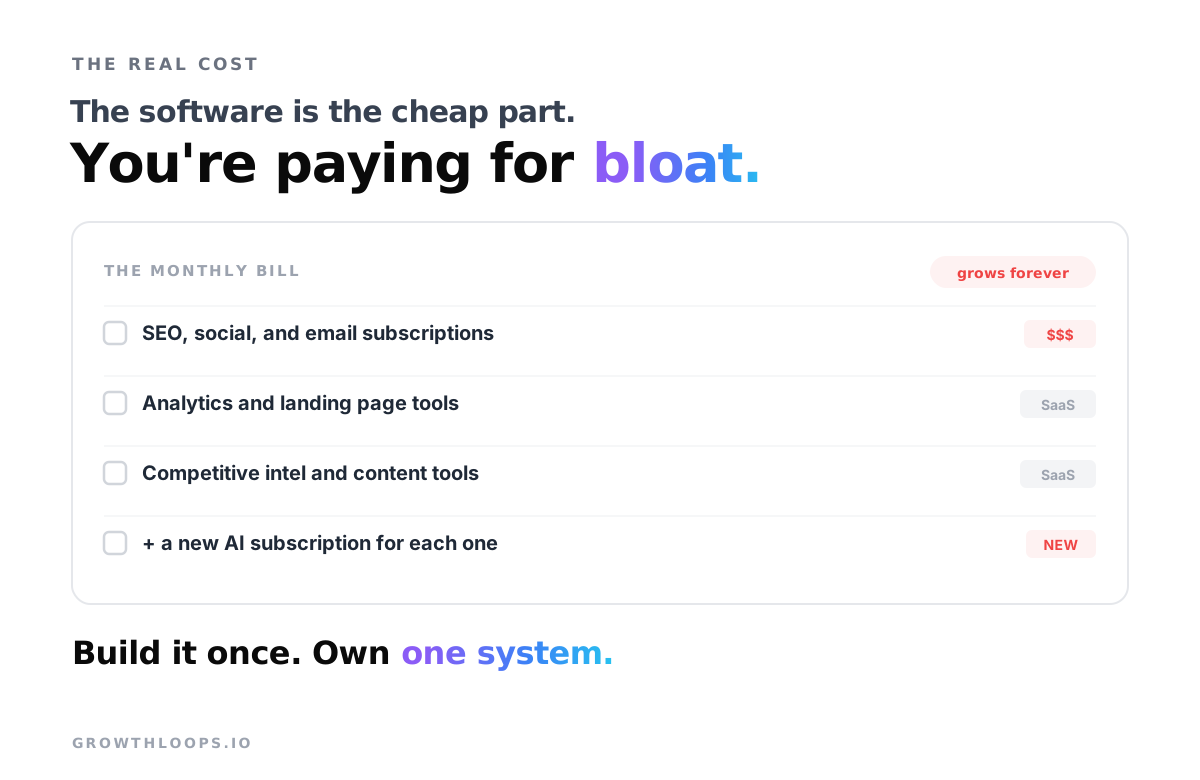
Most founders get this backward. They assume an agent-powered marketing team means a bigger pile of expensive AI subscriptions. It is the opposite. The tooling layer is close to a rounding error. The cost that quietly balloons a marketing budget is the rented software stack: a tool for this, a subscription for that, an AI add-on bolted onto each one. Your marketers are not the line that is too big. The treadmill of point tools you ask them to babysit is. Agents collapse that stack and hand the capability back to your team.
I run my own marketing on a team of agents inside Claude Code. So this is not a forecast. It is the cost structure I operate on every day.
How much does it cost to run a marketing team on AI agents?
The tooling is cheap. The skill is the investment, and your people are the asset.
An agent marketing team runs on three cost layers, and only one of them is software.
Layer one: the tooling. This is the AI subscription plus a few connected tools. It is the smallest cost in the entire model, and the one founders overestimate the most. A small team building in Claude Code is not buying ten AI SaaS seats. They are building agents in one environment. This is the layer everyone fixates on, and it is the layer that barely moves your budget.
Layer two: the skill to build. This is the real investment, and it is a one-time cost that compounds. Your team learns how to design an agent: the role, the system prompt, the brand context, the feedback loop. That is a learning curve, not a license fee. You pay it once. After that, every new agent your team builds is close to free.
Layer three: your people. Agents produce. Your marketers decide what ships. They set strategy, review output for accuracy and brand, and own the number. This is not a cost to cut. It is the part of the budget that matters most, and agents give it back its time. You stop paying for talented people to push buttons across ten tools, and you start paying for the judgment and taste you hired them for.
Stack those up and the math inverts what most founders expect. The dollars go to skill and people, not to software.
Where does a marketing budget actually leak money?
Into the rented stack, not the people.
Walk through a typical marketing budget and the line that grows fastest is rarely the team. It is software. A tool for SEO. A tool for social. A tool for email. A tool for analytics. A tool for landing pages. Each one is another seat, another renewal, another login, and another integration that breaks the week a vendor changes an API. Nobody decides to build a bloated stack. It accretes, one "we need a tool for this" at a time.
AI made the sprawl worse, not better. Now there is an AI tool for every one of those jobs too. An AI copywriter. An AI SEO assistant. An AI social scheduler. Buying ten AI subscriptions is the same trap as before with a fresh coat of paint. You are paying ten vendors to each do a slice of a job your team could own in one place, and you are renting the result instead of owning it.
Your marketers feel this before anyone. They are the ones stitching ten tools together, exporting from one to paste into another, and losing a day to a broken sync. The bloat does not only cost money. It costs your best people the hours you hired them for. That is the line agents bend. Not your team. The stack.
How do AI agents cut SaaS tool bloat?
They replace a stack of point tools you rent with capability you build once and own.
Building agents collapses the stack. Instead of buying a tool for each task, you build an agent for each task in Claude Code. Content, competitive intel, repurposing, quality control, outbound. One environment. When a new need shows up, you build an agent for it instead of adding a subscription for it. The capability is yours. It does not have a renewal date, a per-seat price, or a roadmap controlled by someone else.
This is the part that compounds in your favor. Every job you move from a rented tool to a built agent is a line item that stops growing. The stack stops sprawling. You are not bolting on tool number eleven. You are building the one capability that made tools three through ten unnecessary.
What does an agent team save you?
The rented stack, and your team's time.
Most cost conversations about AI agents jump straight to cutting people. That misses the point, and it picks a fight with the wrong line. The budget line that quietly grows forever is software. Every new need, another subscription. Every new subscription, another seat, another renewal, another thing to maintain.
An agent team bends that line down. You build the capability once instead of renting a tool for every task, so the stack stops sprawling. And because agents take the repetitive execution, your marketers get their hours back for the work you hired them to do. Fewer subscriptions, one system your team owns, and people freed from the busywork.
That is the real saving, and it is why this is an ownership story, not a cost-cutting one. You stop renting your marketing capability from a dozen vendors, and you start owning it.
Can a 3-person marketing team really produce like a team of 10?
Yes, when agents take the busywork and your people do the work only they can do. The difference is what your team spends its time on.
In a traditional setup, your people do the volume work by hand. They write each blog post. They pull each report. They research each competitor. Output is capped by how many hours they have and how many tools they have to wrangle.
In an agent setup, the same people stop doing the repetitive work and start directing it. One person owns content strategy and reviews what the content agents produce. One owns demand and pipeline. One owns the build, creating and tightening agents as needs change. The agents handle the volume. Your people handle the judgment.
The output is not only larger. It is more consistent. Every piece runs through the same quality check and the same persona targeting. The variance that comes from a tired Thursday or a rushed launch goes away.
This only works if someone on the team knows how to build the system. That is the part worth investing in. A team with that skill produces far beyond its headcount. Your team, multiplied.
What is the real cost most founders miss?
The real cost is learning to build, not the monthly bill.
This is the part that does not show up on an invoice. Your team has to learn a new skill: designing agents with defined roles, writing system prompts, feeding in brand context, and building feedback loops so the output gets sharper over time. That is operator work. It is the hard part, and it is the part worth paying for.
The good news is that it is a one-time cost that compounds. The first agent is the hardest. By the fifth, your team is fast. By the tenth, they are building new capacity in an afternoon. The skill does not depreciate when a tool updates, because you learned the principles, not one vendor's interface.
The trap is treating this as a software purchase. Founders who buy a stack of AI tools and expect a marketing team get a pile of subscriptions and mediocre output. Tools have no role. Agents do. The gap between the two is the skill your team builds, and that skill is the thing you are investing in.
What does the agent team cost over time?
The cost curve bends the right way. High at the start when your team is learning, low and flat once they can build.
A rented stack gets more expensive the more you do. Every new need is another tool, another seat, another renewal, and the bill only climbs. The cost scales with the work.
An agent team front-loads the cost into the learning, then flattens. Once your team can build, adding capacity does not mean adding a subscription. It means building another agent. Your output can grow without your costs growing at the same rate. That is the part a lean founder feels most: capacity that scales faster than spend.
The team that started building three months ago already has the advantage. Their brand context is more refined. Their agents are more accurate. Their people are faster builders. That lead compounds, and it is hard for a late mover to close.
The bottom line for a founder weighing the spend
The cheap part is the software. The valuable part is your team knowing how to build.
The real comparison is not agents versus marketers. It is owning your marketing capability versus renting it one subscription at a time. Build the skill once and your team owns capacity that grows without the stack growing with it. Keep buying tools instead, and you get the bill without the ownership.
The teams winning at your stage are not the ones with the most AI tools. They are the ones whose people learned how to build. That is where the money should go: into your team, not your stack.
If you want to see what it takes to train a marketing team to build and run their own agents, that is the conversation I have every week. Start there, and the cost question answers itself.