What Is Claude Code? A Non-Technical Guide for Marketing Teams
If you have heard people talking about Claude Code and thought "that sounds like a developer tool, not for me," this post is for you.
Claude Code is not a developer tool. It is a tool that lets anyone build things by describing what they want in plain English. No programming language. No syntax to memorize. No terminal commands to learn. You describe what you need, and it builds it.
I am a marketing leader. I have never written a line of Python in my life. In the past few months, I have used Claude Code to build 25 AI marketing agents, a blog publishing pipeline, a social media analytics dashboard, and an entire marketing operating system. All by describing what I wanted in regular sentences.
This guide will explain what Claude Code actually is, what it can do for marketing teams, and how to get started without any technical background.
What Claude Code actually is
Claude Code is an AI assistant that runs in your terminal (the text-based interface on your computer). You type what you want. It builds it.
That sounds abstract, so here is a concrete example. I typed something like: "I need an AI agent that scans competitor ads across Meta, LinkedIn, and Google, extracts messaging patterns, and identifies gaps we can exploit." Claude Code built the entire thing. The logic, the workflow, the output formatting. I tested it, told it what to change, and it refined until the output was exactly what I wanted.
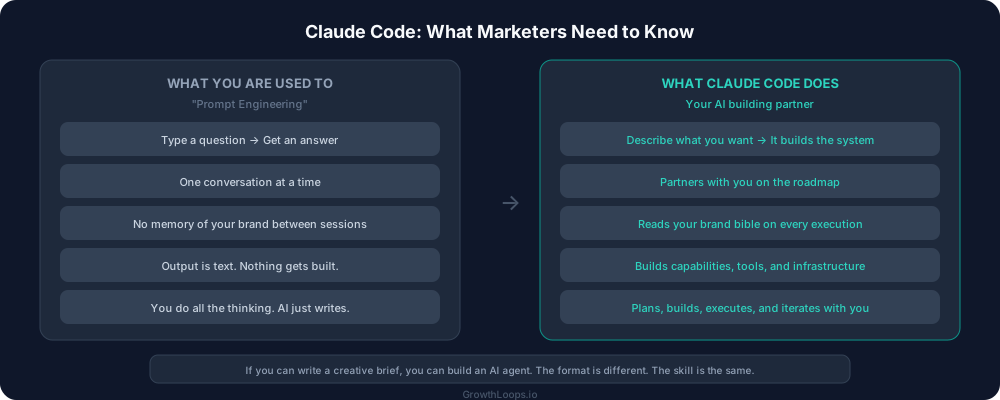
The key difference between Claude Code and tools like ChatGPT is scope. ChatGPT answers questions. Claude Code builds systems. It creates files, writes code, reads your existing project, connects to external tools, and executes multi-step workflows. It is not a chatbot. It is a builder.
Why marketing teams should care
Marketing teams are drowning in repetitive work that requires strategic thinking but not creative genius. Competitive research. Content reformatting. Performance reporting. Email personalization. QC reviews. These tasks eat hours every week and they follow predictable patterns.
Claude Code lets you turn those patterns into AI agents that run on demand. Not by hiring a developer to build them for you. By describing the workflow yourself and letting Claude Code do the building.
Here is why that matters:
You know the requirement better than any developer. A marketer who has done competitive research 500 times knows exactly what a good competitive analysis looks like. They know which data points matter, which ones are noise, and how the output should be structured. That expertise is the specification. Claude Code is the builder.
The feedback loop is instant. You describe what you want. Claude Code builds it. You test it, see what is off, and describe the fix. It rebuilds. In an afternoon, you have a working tool that would have taken weeks to spec, scope, and build through a traditional development process.
The tools compound. Every agent you build makes the next one easier. Your brand context gets more refined. Your voice rules get tighter. Your persona definitions get sharper. The system gets smarter over time because you are continuously improving the foundation.
What marketing teams are building with it
Here are real examples from my own work:
Content agents. Blog writers, LinkedIn post generators, TikTok script creators, and email sequence builders. Each one reads your brand bible and writes in your voice, not a generic AI voice.
Intelligence agents. Competitive ad scanners, market research tools, podcast transcript miners, and trend monitors. Each one delivers structured intelligence you can act on immediately.
Operations tools. Quality control systems that check every piece of content against your brand rules. Analytics dashboards that you design to show the metrics that matter to you. Publishing pipelines that take a blog post from draft to live on your website in minutes.
Sales enablement. Objection coaches, meeting prep briefs, cold email writers, and growth audit generators. Each one trained on your specific buyer personas and their objections.
None of these required a developer. All of them were built by describing the workflow and letting Claude Code handle the technical execution.
How to get started
Step 1: Install Claude Code. It runs on Mac, Windows, and Linux. The installation takes about five minutes. You open your terminal, run the install command, and you are ready.
Step 2: Start with one painful task. Do not try to build a marketing operating system on day one. Pick the one task that eats the most of your time each week. Competitive research. Content reformatting. Performance reporting. Whatever it is, start there.
Step 3: Describe what good looks like. This is the most important step. Before you ask Claude Code to build anything, write down what the perfect version of that task looks like. What are the inputs? What are the outputs? What does good look like? What does bad look like? This description becomes the instruction set for your AI agent.
Step 4: Build and refine. Tell Claude Code what you want. Review the output. Describe what needs to change. Repeat. Most people have a working first version within an hour or two.
Step 5: Build the brand context. Once you have your first agent working, create a CLAUDE.md file with your brand voice rules, personas, and messaging pillars. Every agent you build after that reads this file, which means every agent sounds like your brand from day one.
The mental model that matters
The biggest barrier to marketing teams using Claude Code is not technical skill. It is the assumption that building tools requires coding.
It does not. Building tools with Claude Code requires the same skill that makes someone a good marketing leader: the ability to clearly describe what good looks like. If you can write a creative brief, you can build an AI agent. The format is different. The skill is the same.
Claude Code is not replacing marketers. It is giving marketers the ability to build their own tools for the first time in the history of the profession. The marketers who learn to build will have a compounding advantage over those who wait for someone else to build for them.
The tool is here. The learning curve is shorter than you think. And the first agent you build will change how you think about every task that follows.