Why I Built 20 AI Agents Instead of Hiring a Marketing Team
When I launched GrowthLoops, I had a choice. I could hire a small marketing team to run my own marketing. A content person, a demand gen person, maybe a designer. Or I could build AI agents to handle the work myself.
I chose the agents. Not because I wanted to prove a point about AI. Because the math did not work any other way.
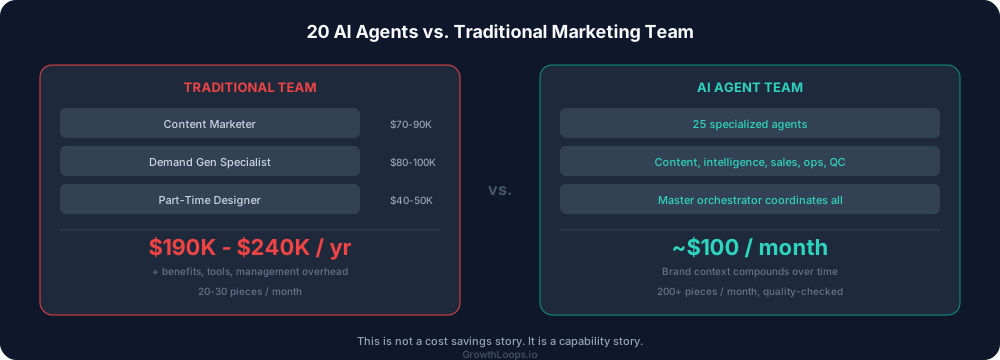
A content marketer costs $70,000 to $90,000. A demand gen specialist costs $80,000 to $100,000. A part-time designer costs $40,000 to $50,000. That is $190,000 to $240,000 in salary alone before benefits, tools, and management overhead. For a fractional CMO practice in its first year, that is not a viable burn rate.
But the work still needed to get done. I needed competitive intelligence. I needed content across LinkedIn, email, blog, and TikTok. I needed creative assets. I needed outbound email. I needed a strategy framework I could use with clients. I needed quality control on everything going out the door.
So I built an agent for each of those jobs. Twenty agents in total. Each one handles a specific function that would normally require a dedicated person or an expensive agency.
What twenty agents actually cost
Here is the honest accounting.
My Claude API costs run about $100 per month. Some months a bit more if I am running heavy competitive scans or generating large content batches. But it is consistently in the $100 to $150 range.
That is $1,200 to $1,800 per year to run the equivalent output of a three-person marketing team. Compare that to $190,000 or more in salary.
Now, I want to be honest about the investment that number does not capture. Building the agents took time. Significant time. I spent weeks building the brand bible, the persona definitions, the voice rules, and the agent instructions. That was real work.
But that work was also strategic work that I would have done anyway. Whether I hired a team or built agents, I still needed to define the brand, the personas, the voice, and the messaging pillars. The difference is that when I did that work for a human team, it lived in a Google Doc that nobody read after the first week. When I did it for the agents, it became an operating system that gets referenced on every single execution.
What the agents handle
Here is the roster:
Content creation. A blog writer, a LinkedIn post writer, a TikTok script generator, an email sequence builder, and a content repurposing engine that turns one piece into dozens. Every piece follows the brand voice rules, targets a specific persona, and maps to a messaging pillar.
Intelligence and research. A competitive ads scanner, a LinkedIn intelligence monitor, a Lenny's podcast miner, and a daily AI news brief. These agents keep me informed about what competitors are doing, what the market is talking about, and what trends are relevant to my clients.
Sales and outbound. A cold email agent, an objection coach, an authority content generator, and a meeting prep agent. These handle everything from writing personalized outreach to preparing for discovery calls.
Strategy and planning. A content strategist, a full marketing strategy audit, and a growth audit writer. These produce the strategic deliverables that drive my client work and my own positioning.
Quality and operations. A quality control agent that reviews everything against the brand rules, a visual marketing agent for creative briefs, and the master orchestrator that coordinates all the others.
What agents cannot replace
I need to be direct about the limitations.
The agents cannot replace relationship building. They cannot sit in a room with a founder and read the emotion behind what they are saying. They cannot make the judgment call about whether a company should bet on partnerships or paid media based on a gut read of the CEO's risk tolerance.
They cannot replace original thinking. They can execute a strategy. They cannot invent one. The strategic direction still comes from me. The positioning choices, the campaign bets, the persona prioritization. Those are human decisions.
They cannot replace presence. Showing up to a conference, doing a podcast interview, being on a stage. The agents handle the scale work. The human handles the trust work.
What the agents replace is the execution layer between strategy and output. The research, the drafting, the formatting, the QC, the reporting. All the work that is essential but that does not require human judgment on every repetition.
Why this matters beyond my business
I am one person running a fractional CMO practice. But the same math applies at scale.
A B2B SaaS company at $15M ARR with a five-person marketing team is spending $500,000 to $700,000 on that team per year. If each team member builds AI agents that handle their repetitive work, the team's effective output doubles or triples without adding headcount. The five-person team produces what a fifteen-person team used to produce.
That is not about replacing people. It is about making people dramatically more effective. The demand gen person who used to spend two days on a competitive report now spends 15 minutes reviewing the agent's output and the rest of the time on strategy. The content marketer who used to write three LinkedIn posts a week now produces thirty because the repurposing engine multiplies everything.
The headcount does not shrink. The output per person explodes. And the quality stays consistent because the QC agent checks everything.
The real advantage is compounding
Every agent I build makes the system smarter. The brand bible gets more refined with every engagement. The persona definitions get sharper. The voice rules get tighter. The objection library grows.
A human team member who leaves takes their institutional knowledge with them. The agents retain everything. Two years from now, the GrowthLoops marketing operating system will have the accumulated strategic intelligence from every client engagement, every competitive scan, every campaign we have ever run.
That knowledge compounds. And it is what makes the agent-first approach not just cheaper but fundamentally better over time.
The question is not whether you should build AI agents for your marketing team. The question is how much compounding advantage you are leaving on the table every month you wait.