Why Your AI Marketing Pilot Failed in Week Three (And How to Fix It)
Your AI marketing pilot did not fail because the technology was not ready. It failed because you ran a tool experiment instead of designing a team. A tool has no role, no owner, and no feedback loop. So week one looked promising, week two got quiet, and by week three nobody could say what the thing was actually for. That is not an AI problem. That is a design problem, and it is fixable.
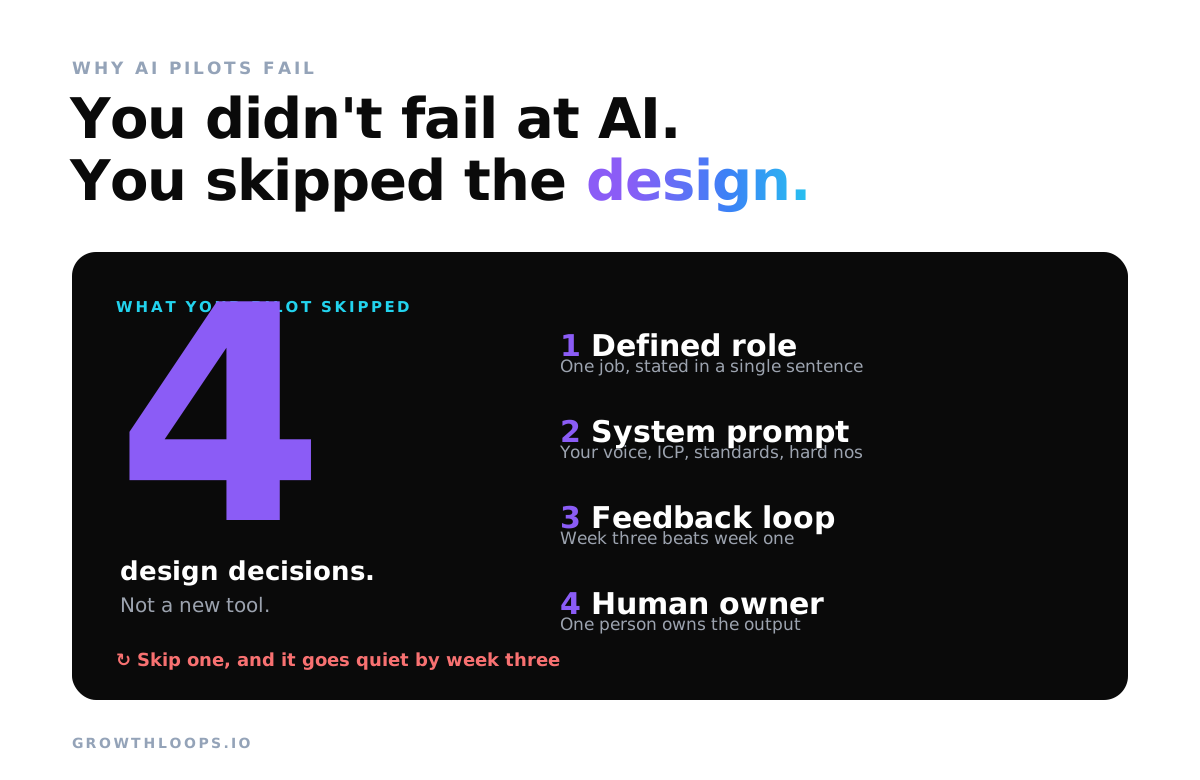
I teach go-to-market teams to build AI agents inside Claude Code, and the week-three fizzle is the most common story I hear. The fix is not a better tool. It is four design decisions almost every pilot skips.
Why do most AI marketing pilots fail in week three?
Most AI marketing pilots fail in week three because no one designed the agent as a team member. They bought access to a tool, asked it to write some copy, and called it a pilot. A tool sits there until someone prompts it. An agent has a job it does whether or not you are watching.
Week one is exciting because the novelty carries it. By week three the novelty is gone and the structure was never there. No one owns the output, so no one notices when it drifts. No feedback loop exists, so it never gets better. The work quietly goes back to the humans, and the pilot gets written up as "we tried AI, it didn't stick."
This is the Morgan story. VP of Marketing, small team, board asking about AI ROI, a previous pilot that fizzled and made everyone gun-shy. The diagnosis is almost always the same. You did not fail at AI. You skipped the team design.
What is the difference between an AI tool and an AI agent?
An AI tool responds to a prompt. An AI agent holds a defined role and produces a specific output you can hold it accountable for. That difference is the whole ballgame.
A tool is ChatGPT in a browser tab. You go to it, you ask, you copy, you leave. Nothing about it is yours. Nothing compounds. The next person who uses it gets a different result on a different day.
An agent in Claude Code has a name, a job, and a system prompt that encodes how your company does that job. Your content agent knows your brand voice, your ICP, and your banned-words list. Your competitive intel agent knows which competitors matter and what angles to watch. The agent does not start from zero every time. It starts from your standards.
GrowthLoops is built on this distinction. The teams winning right now are not the ones with the most AI subscriptions. They are the ones whose agents have real roles.
What does a real AI agent need to actually work?
A real AI agent needs four things: a defined role, a system prompt, a feedback loop, and a human who owns the output. Skip any one of them and you get a week-three fizzle. Build all four and you get a team member.
A defined role. One job, stated plainly. "Repurpose every webinar into five LinkedIn posts and one blog draft." Not "help with marketing." A role you cannot describe in one sentence is a role the agent cannot hold.
A system prompt. This is the agent's operating manual. Your brand voice rules, your persona definitions, your formatting standards, your hard nos. The system prompt is what makes the output sound like your company instead of generic AI. Most failed pilots had no system prompt at all. They had a chat window.
A feedback loop. A way for the output to get better over time. The human owner reviews the work, marks what was wrong, and that correction goes back into the system prompt. Week three should be better than week one. With a loop, it is. Without one, the agent makes the same mistake forever and you stop trusting it.
A human owner. One person on the team is responsible for that agent's output quality. Not "the team." A person. They review it, they refine it, they decide when it ships. Shared ownership is no ownership, which is exactly why the pilot went quiet.
How do you fix a failed AI marketing pilot?
You fix a failed pilot by rebuilding it as a team design instead of restarting it as a tool experiment. You do not need a new vendor. You need to add the four things the first attempt skipped.
Start with one agent, not ten. Pick the most repetitive, predictable workflow your team runs. Content repurposing is a good first choice because the input and output are clear and the volume is high.
Give that agent a one-sentence role. Write it a system prompt that captures how your team already does the work well. Assign one person to own its output. Then build the feedback loop: that owner reviews the work weekly and feeds every correction back into the prompt.
By week three you will have the opposite of the fizzle. The agent will be more accurate than it was on day one, because the loop made it that way. That single working agent becomes the proof point that gets the rest of the team building.
Why is this an operator problem, not an engineering problem?
Building the agent is the easy part. Designing the role, the system prompt, the feedback loop, and the way it fits into your existing pipeline motion is the hard part, and that is operator work, not engineering work. Your engineers can stand up the infrastructure. They cannot decide what good marketing output looks like for your ICP.
That decision requires someone who understands positioning, buyer psychology, and your competitive dynamics. The most valuable person on a marketing team right now is the one who can look at an agent's draft and instantly name what is strategically wrong with it. Not the typos. The wrong persona, the wrong angle, the wrong competitive frame.
This is why a failed pilot is rarely a sign your team cannot do AI. It is usually a sign no one on the team was asked to design the agent like they would design a hire. Define the role. Set the standards. Own the output. Build the loop. Marketers already know how to do this for people. The same instinct works for agents.
Where to start
If your last pilot fizzled in week three, the lesson is not that AI does not work for marketing. The lesson is that an agent without a role, a prompt, a loop, and an owner is just an expensive chat window.
Your team already knows marketing. The four design decisions above are the part no one taught them. Once they have those, they can build agents that hold a job and get sharper every week, on the team you already have.
If you want a second set of eyes on why your pilot stalled, a GrowthLoops growth audit will map your most repetitive workflows to the first one or two agents worth building, and show your team how to design them so week three looks better than week one.