Why Your Next Marketing Hire Should Be a GTM Engineer
If you are a B2B SaaS company with a marketing team of three to eight people, your next hire is probably on the roadmap as a content marketer, a demand gen specialist, or a marketing ops person.
I am going to make the case that none of those are the right call. Your next hire should be a go-to-market engineer.
Not instead of a marketer. A marketer who can build. Someone who understands positioning, personas, and pipeline and who can also build AI agents, connect systems, create dashboards, and automate the workflows that eat your team's time.
This role did not exist two years ago. Right now, it is the highest-leverage hire in marketing.
What a GTM engineer actually does
A GTM engineer sits at the intersection of marketing strategy and technical execution. They do not replace your content person or your demand gen lead. They multiply them.
Here is what a typical week looks like:
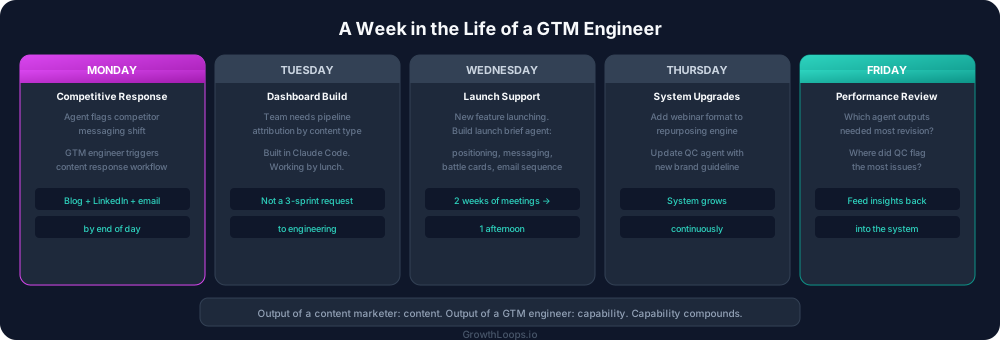
Monday. The competitive ads agent flags a messaging shift from your top competitor. The GTM engineer reviews the output, identifies the gap, and kicks off a content response workflow. By end of day, the blog post is drafted, the LinkedIn posts are generated, and the email sequence is queued.
Tuesday. The marketing team needs a dashboard that shows pipeline attribution by content type. The GTM engineer builds it in Claude Code. Not a request to the engineering team that takes three sprints. A working dashboard, built and deployed by lunch.
Wednesday. A new product feature is launching next week. The GTM engineer builds a launch brief agent that takes the product spec and generates positioning options, messaging frameworks, battle cards, and a launch email sequence. The product marketer reviews and refines. What used to take two weeks of cross-functional meetings happens in an afternoon.
Thursday. The content repurposing engine needs a new output format for a webinar campaign. The GTM engineer adds it. The quality control agent needs an additional check for a new brand guideline. The GTM engineer updates it. The system grows continuously.
Friday. The GTM engineer reviews the week's agent performance. Which outputs needed the most human revision? Where did the QC agent flag the most issues? These insights feed back into the system, making every agent more accurate.
Why this is the highest-leverage hire
The math is straightforward.
A content marketer produces content. Good content, hopefully. But they produce it linearly. One person, one piece at a time. If you need more content, you need more people.
A GTM engineer builds the system that produces content. They build an agent once and it produces output indefinitely. They build a repurposing engine once and every piece of content gets multiplied. They build a QC system once and every piece of content gets checked automatically.
The output of a content marketer is content. The output of a GTM engineer is capability. And capability compounds in a way that headcount never can.
One GTM engineer with a well-built agent system produces more marketing output than three to four traditional marketing hires. Not because they work harder. Because they build systems that work continuously.
The skills to look for
You are not hiring a developer. You are not hiring a traditional marketer. You are hiring someone who bridges both worlds.
Marketing fluency. They need to understand positioning, personas, buyer psychology, and competitive dynamics. Without this, they will build technically impressive tools that produce strategically worthless output. The strategic layer is not optional.
Systems thinking. They think in workflows, not tasks. When they see a repetitive process, their instinct is to systematize it. They see connections between tools and data sources that other people miss.
Agent building capability. They can use Claude Code or similar tools to build AI agents from natural language descriptions. They do not need to write Python. They need to be able to describe what good output looks like with enough precision that an AI can execute it.
Integration mindset. They think about how agents connect to each other. The competitive intelligence output feeds the content engine. The content engine output feeds the QC system. Everything is part of a larger system.
Quality orientation. They care about output quality, not just output volume. They build QC checks into every workflow. They refine agent instructions based on what they see in the output.
Where to find them
The GTM engineer does not come from a traditional marketing background or a traditional engineering background. They come from the overlap.
Look for marketers who have taught themselves to use AI tools beyond basic prompting. People who have built automations in Zapier or Make and wished they could do more. Marketing ops people who are frustrated by the limitations of their tool stack. Content strategists who think in systems rather than individual pieces.
The title is new. The instinct is not. These people exist on your team already or in your network. They are the ones who, when they see Claude Code for the first time, do not say "that is interesting." They say "I have been waiting for this."
The alternative is falling behind
Every month you operate without a GTM engineer, your competitors who have one are building compounding advantages. Their agent systems get more refined. Their brand context gets sharper. Their content output multiplies. Their competitive intelligence gets faster.
This is not a gradual divergence. It is exponential. A company that started building their marketing operating system three months ago already has capabilities that would take a new starter months to replicate. And the gap widens every week.
The GTM engineer is how you close that gap. Not by hiring more people to do the same work. By hiring one person who builds the system that changes what is possible.