Your B2B SaaS Marketing Team in 2026: Half Human, Half Agent
The best B2B SaaS marketing teams right now do not look like anything we have seen before. They are smaller in headcount and larger in output. They have fewer generalists and more specialists. And half of their "team members" are AI agents with defined roles, system prompts, and performance metrics.
This is not a prediction. It is what I am building today.
I run a fractional CMO practice where 25 AI agents handle the execution layer of marketing. Content creation. Competitive intelligence. Product launches. Outbound email. Quality control. Analytics. Creative briefs. Strategy audits. The agents produce the output. The humans make the decisions.
That model is here. The only question is whether your company is building it or watching competitors who already are.
What the 2026 marketing team looks like
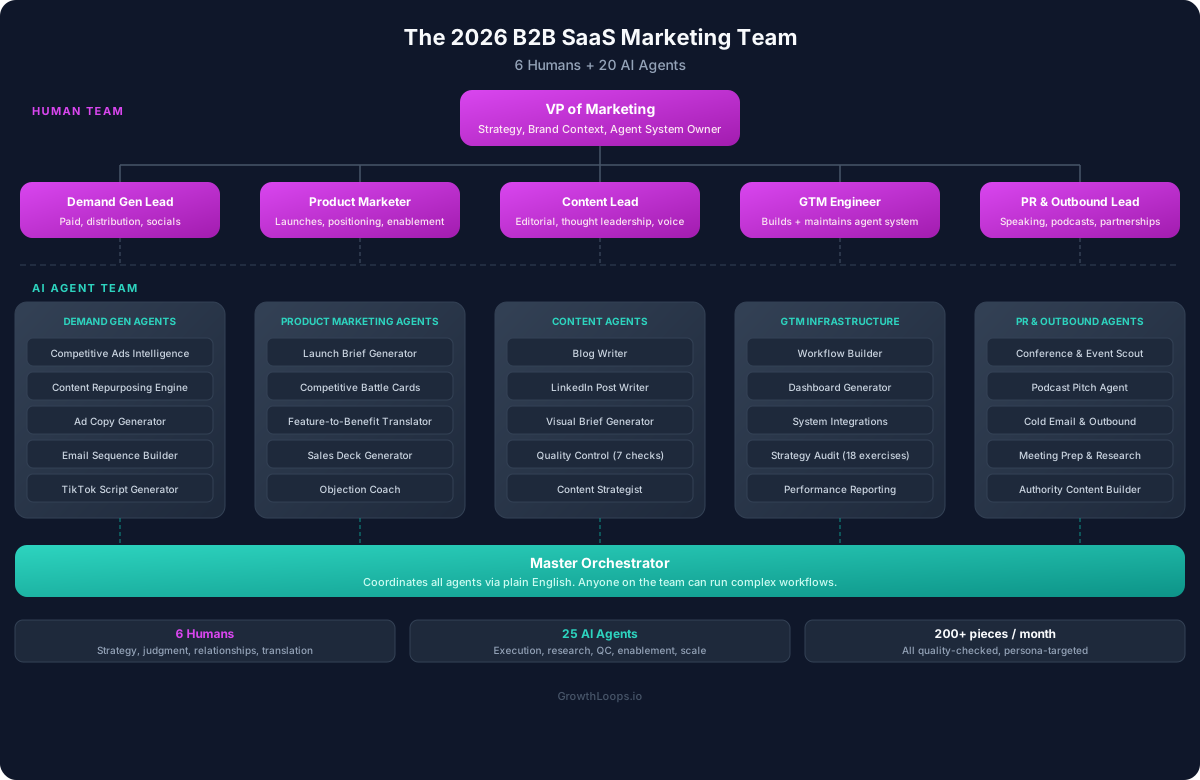
Here is a realistic picture of a B2B SaaS marketing team at a $20M ARR company right now.
Human team (6 people):
A VP of Marketing who sets strategy, manages the agent system, and owns the brand context. This person's primary job is not managing people. It is managing the operating system that produces the marketing output.
A demand gen lead who runs paid channels, content distribution, and social. They review agent output, make strategic decisions about budget allocation, and test new campaign approaches. The agents handle the competitive research, the content repurposing, the ad copy, and the email sequences.
A product marketer who is the translation layer between product and the rest of the go-to-market team. They take highly technical product updates and translate them into human language. They brief the sales team. They develop launch campaigns. They build the battle cards and positioning that every other agent reads. This role has always been critical. Now it scales through agents that generate launch briefs, competitive battle cards, feature-to-benefit translations, and sales decks on demand.
A content lead who manages the editorial system. They write original thought leadership, review agent-generated content for strategic accuracy, and refine the brand voice rules that every content agent follows. They produce 5x more content than a traditional content marketer because the repurposing engine multiplies everything they create.
A GTM engineer who builds and maintains the agent infrastructure. They build new workflows, generate dashboards, connect systems, and approve integrations. They build new agents monthly based on team needs. This role did not exist two years ago. Right now, it is the most important hire on the team.
A PR and outbound lead who handles the work that requires a human face and human relationships. Conference strategy. Podcast appearances. Speaking opportunities. Partnership development. But even here, agents do the scouting. They find the conferences within your ICP, identify the podcasts your buyers listen to, and draft the outreach. The human builds the relationships. The agents find the opportunities.
Agent team (25 agents):
Demand gen agents for competitive ads intelligence, content repurposing, ad copy, email sequences, and TikTok scripts. Product marketing agents for launch briefs, competitive battle cards, feature-to-benefit translation, sales decks, and objection coaching. Content agents for blog writing, LinkedIn posts, visual briefs, quality control, and content strategy. GTM infrastructure agents for workflow building, dashboard generation, system integrations, strategy audits, and performance reporting. PR and outbound agents for conference scouting, podcast pitching, cold email, meeting prep, and authority content.
A master orchestrator that coordinates them all through plain English.
Each agent has a defined role, a performance baseline, and an owner on the human team who is responsible for its output quality.
What this team can do that last year's team could not
The math is straightforward.
A traditional six-person marketing team produces maybe 20 to 30 pieces of content per month, runs two to three campaigns per quarter, and takes a week to produce a competitive analysis.
A six-human, twenty-five-agent team produces 200 or more pieces of content per month (all quality-checked and persona-targeted), runs continuous campaigns with real-time competitive response capability, and produces a competitive analysis in 15 minutes.
The humans are not working harder. They are working on different things. Instead of writing blog posts, the content lead is refining the brand voice system and making editorial decisions about which topics to pursue. Instead of manually translating release notes, the product marketer is shaping the positioning strategy and reviewing agent-generated launch materials. Instead of pulling reports, the GTM engineer is building new workflows that connect the system to new channels. Instead of manually researching competitors, the demand gen lead is making strategic decisions based on intelligence that arrives automatically.
The output is not just larger. It is more consistent. Every piece of content passes through the same QC system. Every email follows the same persona-targeting framework. Every competitive analysis uses the same methodology. The variance that comes from different people having different standards on different days disappears.
The transition takes months, not years
Most marketing teams cannot flip a switch and become half-agent overnight. But the transition is faster than people think.
Stage 1: Individual agents (Month 1 to 2). Each team member builds one or two agents for their own workflows. The demand gen person builds a competitive intelligence agent. The content marketer builds a repurposing engine. The product marketer builds a launch brief generator. These are personal productivity tools, not team infrastructure.
Stage 2: Shared system (Month 2 to 4). The individual agents get connected into a shared system with a common brand context. Output from one agent feeds into another. The QC agent reviews everything. The team starts operating as a human-agent hybrid.
Stage 3: The orchestrator (Month 4 to 6). A master orchestrator gets built that coordinates the agents. Anyone on the team can run complex workflows by describing what they need. The system becomes accessible to the whole team, not just the people who built it.
Stage 4: The GTM engineer (Month 6 onward). The team formally creates the GTM engineer role. This person builds workflows, connects systems, generates dashboards, and maintains the agent infrastructure. New agents get built monthly based on team needs. The system grows continuously.
What has to change in how we hire
The skills that matter for a marketing hire right now are different from the skills that mattered two years ago.
Less important: Writing speed. Manual research ability. Tool-specific expertise. Volume output.
More important: Strategic judgment. Brand thinking. Agent specification (the ability to describe what good output looks like with enough precision that an AI can execute it). Systems thinking. Quality assessment.
The best marketers right now are the ones who can look at an agent's output and immediately identify what is strategically wrong with it. Not grammatically wrong. Strategically wrong. Wrong persona targeting. Wrong messaging angle. Wrong competitive framing.
That skill requires deep marketing expertise. It requires understanding positioning, buyer psychology, and competitive dynamics. The people who have those skills become dramatically more valuable in an agent-augmented world because they are the ones who make the system intelligent.
The companies that are moving now are winning
This is not a gradual shift where everyone adopts at the same pace. It is a step function. The companies building their marketing operating system right now have a compounding advantage that late movers cannot close quickly.
The brand context gets more refined with every month. The agents get more accurate. The workflows get more sophisticated. The institutional knowledge accumulates. A company that started building three months ago already has a compounding advantage over a company that starts next quarter.
The technology is ready. The frameworks exist. The playbook is written. The only variable is when you decide to start building.
Half human, half agent is not a vision for the future. It is the operating model of every marketing team that is competing at the highest level right now.